

- Featured
- Research
- Education
- Social Sciences
New WT-Led Study Hopes to Prevent Knowledge Gaps in Reading for Young Children
Copy by Chip Chandler, 806-651-2124, cchandler@wtamu.edu
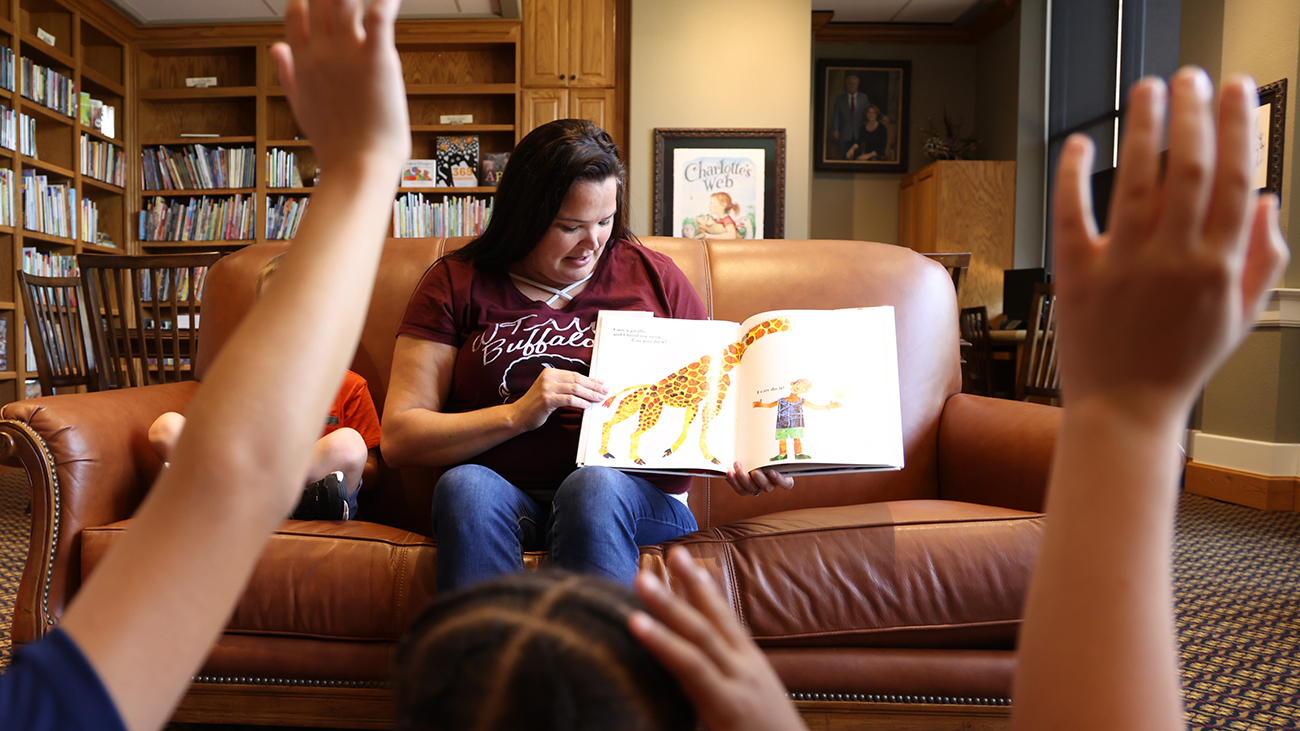
Photo: Education graduate student Julie Dalman leads an exercise in West Texas A&M University's Williams Reading Room.
CANYON, Texas — A West Texas A&M University psychology professor is leading a new study aimed at preventing gaps in reading skills before children even start kindergarten.
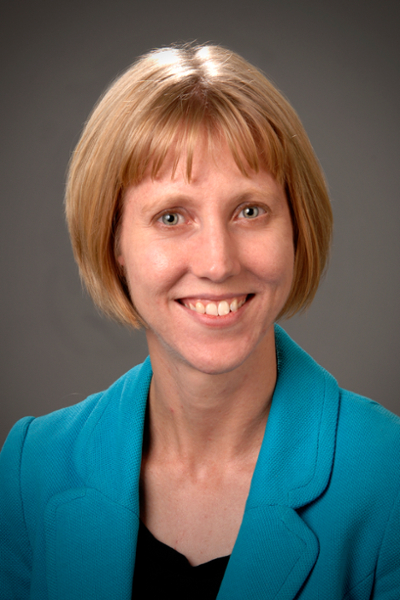
Dr. Ashley Pinkham, associate professor of psychology in WT’s College of Education and Social Sciences, recently won a four-year, $1.5 million grant from the Institute of Education Sciences to fund research into how taxonomically organized, or systematically classified, books and media could help prevent a knowledge gap between educationally at-risk students. The grant includes $200,000 in funding for WT.
“There is a well-documented discrepancy between educationally at-risk children and children from wealthier backgrounds,” Pinkham said. “This achievement gap first emerges in elementary school and gets wider and wider. With a traditional intervention approach, you wait until they start to fail and swoop in to get them caught up. I’m not interested in that. What we’ve said as a research group is let’s prevent those discrepancies from ever occurring.”
“Urban poverty is different than rural poverty. Children who grow up on a farm have a much better foundation for biology and sciences than urban children,” Pinkham said. “Children in rural settings also are at risk of falling behind, but their understanding of the world is different because they’ve had different experiences, so we want to understand what their unique needs are.”
Taxonomically organized educational materials teach children to think in terms of hierarchical organization.
“In a lot of early childhood classrooms, lessons are organized around themes — for example, ‘down on the farm.’ That’s a great way of thinking about these objects, but it doesn’t allow you to generalize your knowledge. If a child runs across something totally unfamiliar, they may have difficulty recognizing that it may also belong on a farm,” Pinkham said.
But with taxonomical organization, children are taught to think in broader concepts first before narrowing them down.
“For instance, a beagle is a type of a dog, and a dog is a type of an animal. To make your memory as efficient as possible, you naturally store information at the highest level. If you are taught that animals need food to survive, you store that at the level of ‘animal,’ then filter it down to ‘mammal,’ ‘dog,’ etc.,” Pinkham said. “If you show me an animal that I’ve never seen before, like a platypus, then I can assume, even if I’ve never encountered it, that it probably needs food to survive because it’s an animal.
“It’s a much more powerful way of storing information because you can generalize it to new experiences,” she said.
In terms of reading comprehension, students must be able to both decode the sounds of the letters and comprehend what the word means.
“A lot of traditional approaches focus on the decoding aspect and only the decoding aspect,” Pinkham said. “The problem is, the number of sounds in the English language is finite, so if I encounter the word ‘cat’ for the first time, I can sound it out but still not be able to fully comprehend what’s in front of me.
“We believe that if we focus on building children’s knowledge, their understanding of concepts, their understanding of what makes an insect an insect, then if they encounter a new word, they will be able to understand it, not just sound it out.”
Such impactful projects are key to WT’s quest to become a Regional Research University, as laid out in the University’s long-term plan, WT 125: From the Panhandle to the World.
About West Texas A&M University
WT is located in Canyon, Texas, on a 342-acre residential campus. Established in 1910, the University has been part of The Texas A&M University System since 1990. With enrollment of more than 10,000, WT offers 60 undergraduate degree programs, 40 master’s degrees and two doctoral degrees. The University is also home to the Panhandle-Plains Historical Museum, the largest history museum in the state and the home of one of the Southwest’s finest art collections. The Buffaloes are a member of the NCAA Division II Lone Star Conference and offers 14 men’s and women’s athletics programs.
—WTAMU—