Beginning Algebra
Tutorial 19: Practice Test on Tutorials 11 - 18
 Learning Objectives Learning Objectives
After completing this tutorial, you should be able to:
- Take a test on topics covered in tutorials 11 - 18 in
this website.
|
Special Notes about Tutorial 19:
-
I can not guarantee
you will pass
your test after going though any of the tutorials in this website or
this
practice test. However, it will definitely help you to better
understand
the topics covered better.
-
Disclaimer: WTAMU and Kim Seward are not
responsible
for how a student does on any test or any class for any reason
including
not being able to access the website due to any technology
problems.
-
There are no videos on this page.
|
Introduction
It is important to note that, chances are, I'm not your
math instructor. You
need to check with your math teacher as to things like when your next
math
test is and what it covers. It may cover more material on the
test
than what is in this practice test. Just note that there are
other practice tests at this website. So, after finding out what is on
your test (if you have one) do the practice test(s) problems that go
with
the test you are preparing for. If you are not in a class or are
not having a test soon, this practice test is still good practice to go
through and check to make sure you are understanding this material
before
moving on - kind of like a spot check. The material on this practice
test goes with Tutorial 11: Simplifying
Algebraic Expressions, Tutorial
12: The Addition Property of Equality, Tutorial
13: The Multiplication Property of Equality, Tutorial
14: Solving Linear Equations (Putting it all together), Tutorial
15: Introduction to Problem Solving, Tutorial
16: Percent and Problem Solving, Tutorial
17: Further Problem Solving, and Tutorial
18: Solving Linear Inequalities.
Also note that your teacher may word the problems on
their test a
little differently, may have some different kinds of problems, or may
have
a different number of problems than what is in this practice test.
Again, since I'm probably not your math instructor, I don't know
exactly
how your teacher will set up your math test. Just note that these
problems will help you build an understanding of the concepts presented
and the terms used in math problems. If you have an
understanding
of the problems instead of just memorizing them, then you should do
fine
on these concepts, no matter how the test is set up.
|
Steps to Studying for a
Math Test
|
-
Work through problems. If you are in a
class, you should have
done this on completion of any homework you have done. For
anyone,
you can accomplish this by doing the practice problems found in each
tutorial.
-
Check work on problems. The practice
problems in each tutorial
have links to the answers to them so you can instantly check how you
are
doing. Also, in most math books, the odd answers are found in the
back of the book.
-
Review concepts. Whether you got the
problems right or wrong,
make sure you review over them. If you did get a problem wrong,
make
sure you either review that concept in it's respective tutorial or ask
your math teacher about it. If you don't ask about a problem
before
a test, you are going to kick yourself when it comes up on the
test.
-
Work through problems as if you were taking the
test
- no notes, book,
webpages, etc. This practice test is a perfect way to do
that. After
taking this practice test, check your answers by clicking on the link
to
the answer key found at the bottom of the practice test (before the
'need
extra help on these topics' section)
|
|
It is to your benefit to show as much of the work as
possible on
the problems that have several steps involved.
Make sure that you read the directions carefully,
you wouldn't
believe how many points get taken off math tests for people not
following
directions.
Pace yourself. You do not have to be the
first one done
to do well on the test. Do not panic if there is still time left
to take the test and others are turing it in. Sometimes that
means
they do not know the material and left some of the answers blank.
Do not worry about anyone else but yourself.
Don't rush through a problem.
Another thing that
math teachers take points off for are careless mistakes made by people
that rush through a problem. When those students get their tests
back, they bonk themselves on the head at some of the things that got
counted
wrong, things that they knew how to do.
Check your answers. If you have time, go
back and check
your answers.
Remember to breathe!!!! I know some of you
are scared to
death at the thought of having to take a math test of any kind.
For
you guys, try to relax and don't forget to breathe. (Even if you
aren't scared to take a math test, it is probably a good idea to
remember to breathe, I wouldn't want you to pass out during the
test). If it feels like your brain has left the building during
your test,
just close your eyes and breathe in and out and in and out and your
brain
will return.
Good luck on your test. If you are taking a
math test soon,
don't panic, you are going to do great!!! |
Practice Test
Problems 1a - 1b: Simplify the expressions. |
1a.  |
1b.  |
Problem 2a: Write the phrase as an algebraic expression and
simplify if possible. |
2a. The sum of 8 times a number and 4 subtracted from 16 times
a number. |
Problems 3a - 3c: Solve the given equation. |
3a.  |
3b. 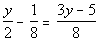 |
3c.  |
Problems 4a - 4f: Solve the following word problems. |
4a The product of 5 and a number is 8 less than 7 times that
number. |
4b. Complimentary angles sum up to be 90 degrees. Find
the measure of each angle in the figure below. Note that since the
angles make up a right angle, they are complementary to each other.
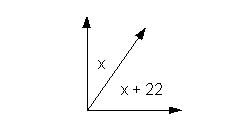
|
4c. 14.4 is what percent of 60? |
4d. You are wanting to buy a stereo system that costs $325
plus tax. If you are going to be taxed 8.25%, how much will be the
final cost of the stereo system? (round to the nearest cent) |
4e. You are traveling down I-40 at a constant speed of 70 mph.
How many hours will it take you to travel 385 miles? |
4f. A total of $1000 is deposited into two simple interest
accounts. On one account the annual simple interest rate is 5% and
on the second account the annual simple interest rate is 7%. The
amount of interest earned for 1 year was $64. How much is invested
in each account? |
Problems 5a - 5c: Solve the inequality and graph the solution
set. |
5a.  |
5b.  |
5c.  |
Need Extra Help on these Topics?

Last revised on July 28, 2011 by Kim Seward.
All contents copyright (C) 2002 - 2010, WTAMU and Kim Seward.
All rights reserved.
|
|