
 Learning Objectives
Introduction
This tutorial reviews multiplying and dividing real numbers and intertwines that with some order of operation and evaluation problems. It also reminds you that dividing by 0 results in an undefined answer. In other words, it is a big no, no.
I have the utmost confidence that you are familiar with multiplication and division, but sometimes the rules for negative numbers (yuck!) get a little mixed up from time to time. So, it is good to go over them to make sure you have them down.
Tutorial
For each real number a, except 0,
there is a unique
real number  such
that
such
that
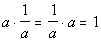
A more common term used to indicate a multiplicative inverse is the reciprocal.
A multiplicative inverse or reciprocal of a real number a (except 0) is found by “flipping” a upside down. The numerator of a becomes the denominator of the reciprocal of a and the denominator of a becomes the numerator of the reciprocal of a.
 Example
1: Write the reciprocal (or multiplicative
inverse)
of -3.
Example
1: Write the reciprocal (or multiplicative
inverse)
of -3.When you take the reciprocal, the sign of the original number stays intact.
Remember that you need a number that when you multiply times the given number you get 1. If you change the sign when you take the reciprocal, you would get a -1, instead of 1, and that is a no no.
Example
2: Write the reciprocal (or multiplicative
inverse)
of 1/5.If a and b are real
numbers and
b is not 0, then

Step 1: Multiply or
divide their absolute
values.
Step 2: Put the correct
sign.
If they have opposite signs, the product or quotient is negative.
Example
3: Find the product (-4)(3).The product of the absolute values 4 x 3 is 12 and they have opposite signs, so our answer is -12.
Example
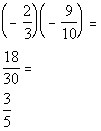
4: Find the product  .
.
Note that if you need help on fractions go to Tutorial 3: Fractions
Example
5: Find the product 
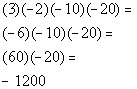 Example
6: Divide (-10)/(-2).
Example
6: Divide (-10)/(-2).The quotient of the absolute values 10/2 is 5 and they have the same signs, so our answer is 5.
Example
7: Divide  .
.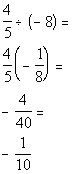
*Mult. num. together
*Mult. den. together
*(+)(-) = -
*Reduce fraction
Note that if you need help on fractions go to Tutorial 3: Fractions
a(0) = 0
and
0/a = 0 (when a does not equal 0)
Example
8: Multiply 0(½).Multiplying any expression by 0 results in an answer of 0.
Example
9: Divide 0/5.Dividing 0 by any expression other than 0 results in an answer of 0.
a/0 is undefined
Example
10: Divide 5/0.
Dividing by 0 results in an undefined answer.
Example
11: Simplify  .
.If you need to review the order of operations go to Tutorial 4: Operations of Real Numbers.
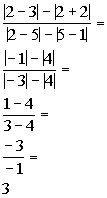
*Subtract
*(-)/(-) = +
Example
12: Evaluate the expression  if x = -2 and y = - 4.
Plugging -2 for x and - 4 for y and simplifying we get:
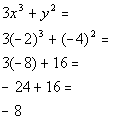
Practice Problems
To get the most out of these, you should work the problem out on your own and then check your answer by clicking on the link for the answer/discussion for that problem. At the link you will find the answer as well as any steps that went into finding that answer.
Practice Problems 1a - 1c: Multiply.
Need Extra Help on these Topics?
http://www.mathleague.com/help/integers/integers.htm#multiplyingintegers
This webpage helps you with multiplying integers.
http://www.mathleague.com/help/posandneg/posandneg.htm#
multiplyingpositiveandnegativenumbers
This webpage goes over multiplying positive and negative numbers
together.
http://www.mathleague.com/help/integers/integers.htm#dividingintegers
This webpage covers dividing integers.
http://www.mathleague.com/help/posandneg/posandneg.htm#
dividingpositiveandnegativenumbers
This webpage goes over dividing positive and negative numbers.
Go to Get Help Outside the Classroom found in Tutorial 1: How to Succeed in a Math Class for some more suggestions.

Last revised on July 25, 2011 by Kim Seward.
All contents copyright (C) 2001 - 2011, WTAMU and Kim Seward. All rights reserved.


