Learning Objectives
Introduction
This tutorial reviews subtracting real numbers and intertwines that with some order of operation and evaluation problems.
I have the utmost confidence that you are familiar with subtraction, but sometimes the rules for negative numbers (yuck!) get a little mixed up from time to time. So, it is good to go over them to make sure you have them down.
Even in this day and age of calculators, it is very important to know these basic rules of operations on real numbers. Even if you are using a calculator, you are the one that is putting the information into it, so you need to know things like when you are subtracting versus adding and the order that you need to put it in. Also, if you are using a calculator you should have a rough idea as to what the answer should be. You never know, you may hit a wrong key and get a wrong answer (it happens to the best of us). Also, your batteries in your calculator may run out and you may have to do a problem by hand (scary!!!). You want to be prepared for those Murphy's Law moments.
Tutorial
a - b = a + (-b)
or
a - (-b) = a + b
Now, you do not have to write it out like this if you are already comfortable with it. This just gives you the thought behind it.
 Example
1: Subtract -3 - 5.
Example
1: Subtract -3 - 5.Subtracting 5 is the same as adding a -5.
Once it is written as addition, we just follow the rules for addition, as shown in Tutorial 5: Adding Real Numbers, to complete for an answer of -8.
Example
2: Subtract -3 - (-5).Subtracting -5 is the same as adding 5.
Once it is written as addition, we just follow the rules for addition, as shown in Tutorial 5: Adding Real Numbers, to complete for an answer of 2.
Example
3: Subtract  .
.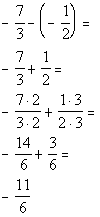
*Mult. top and bottom of 1st
fraction
by 2 and 2nd by 3 to get the
LCD of
6
*Take the difference of the
numerators and write over common denominator 6
Example
4: Simplify  .
.If you need to review the order of operations go to Tutorial 4: Operations of Real Numbers.
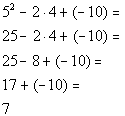
*25 - 8 = 17
Example
5: Simplify 
If you need to review the order of operations go to Tutorial 4: Operations of Real Numbers.
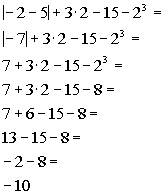
*Exponent
*Multiplication
*7 + 6 = 13
*13 - 15 = -2
Example
6: Evaluate the expression  if x = -2 and y = 5.
Plugging -2 for x and 5 for y and simplifying we get:
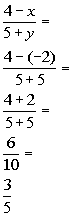
*Rewrite num. as addition of opposite
*Add
*Simplify fraction
Example
7: Is -1 a solution of -x + 4 = 6 + x?Replacing x with -1 we get:
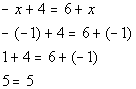
*Take the opposite of -1
*Add
Since we got a TRUE statement (5 does in fact equal 5), then -1 is a solution to this equation.
Practice Problems
To get the most out of these, you should work the problem out on your own and then check your answer by clicking on the link for the answer/discussion for that problem. At the link you will find the answer as well as any steps that went into finding that answer.
Practice Problems 1a - 1b: Subtract.
Need Extra Help on these Topics?
http://www.mathleague.com/help/integers/integers.htm#subtractingintegers
This webpage goes over subtracting real numbers.
Go to Get Help Outside the Classroom found in Tutorial 1: How to Succeed in a Math Class for some more suggestions.

Last revised on July 24, 2011 by Kim Seward.
All contents copyright (C) 2001 - 2011, WTAMU and Kim Seward. All rights reserved.