(Back to the Beginning Algebra Homepage)
(Back to the GRE Math Help Page)
(Back to the THEA Math Help Page)

Beginning Algebra
Tutorial 15:
Introduction to Problem Solving


Learning Objectives

 
After completing this tutorial, you should be able to:
  1. Use Polya's four step process to solve word problems involving numbers, rectangles, supplementary angles, and complementary angles.


Introduction

 
Whether you like it or not, whether you are going to be a mother, father, teacher, computer programmer, scientist, researcher, business owner, coach, mathematician, manager, doctor, lawyer, banker (the list can go on and on).  Some people think that you either can do it or you can't.  Contrary to that belief, it can be a learned trade.  Even the best athletes and musicians had some coaching along the way and lots of practice.  That's what it also takes to be good at problem solving.

George Polya, known as the father of modern problem solving, did extensive studies and wrote numerous mathematical papers and three books about problem solving.  I'm going to show you his method of problem solving to help step you through these problems.


Tutorial


As mentioned above, I use Polya’s four steps to problem solving to show students how to solve word problems.    Just note that your math teacher or math book may word it a little differently, but you will see it all basically means the same thing.

If you follow these steps, it will help you become more successful in the world of problem solving.

Polya created his famous four-step process for problem solving, which is used all over to aid people in problem solving:

Step 1: Understand the problem.
 

Sometimes the problem lies in understanding the problem.  If you are unclear as to what needs to be solved, then you are probably going to get the wrong results.  In order to show an understanding of the problem, you, of course, need to read the problem carefully.  Sounds simple enough, but some people jump the gun and try to start solving the problem before they have read the whole problem.  Once the problem is read, you need to list all the components and data that are involved. This is where you will be assigning your variable.

Step 2:  Devise a plan (translate).
 

When you devise a plan (translate), you come up with a way to solve the problem.  Setting up an equation, drawing a diagram, and making a chart are all ways that you can go about solving your problem.  In this tutorial, we will be setting up equations for each problem.  You will translate them just like we did in Tutorial 4: Introduction to Variable Expressions and Equations.

Step 3:  Carry out the plan (solve).
 

The next step, carry out the plan (solve), is big. This is where you solve the equation you came up with in your 'devise a plan' step.  The equations in this tutorial will all be linear equations.  If you need help solving them, by all means, go back to Tutorial 12: The Addition Property of Equality, Tutorial 13: The Multiplication Property of Equality, or Tutorial 14: Solving Linear Equations (Putting it all together) and review that concept.

Step 4:  Look back (check and interpret).
 

You may be familiar with the expression 'don't look back'.  In problem solving it is good to look back (check and interpret)..  Basically, check to see if you used all your information and that the answer makes sense.  If your answer does check out, make sure that you write your final answer with the correct labeling.


Numeric
Word Problems

 
A lot of numeric types of word problems revolve around translating English statements into mathematical ones.  If you need a review on these translations, you can go back to Tutorial 4: Introduction to Variable Expressions and Equations.

Just read and translate it left to right to set up your equation


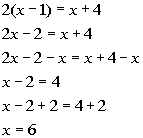
Example 1:  Twice the difference of a number and 1 is 4 more than that number.  Find the number.

 
Step 1: Understand the problem.

 
Make sure that you read the question carefully several times. 

Since we are looking for a number, we will let 

x = a number


 
Step 2:  Devise a plan (translate).


Step 3:  Carry out the plan (solve).


*Remove ( ) by using dist. prop.

*Get all the x terms on one side

*Inv. of sub. 2 is add 2


Step 4:  Look back (check and interpret).

 
If you take twice the difference of 6 and 1, that is the same as 4 more than 6, so this does check.
 

FINAL ANSWER: 

The number is 6.


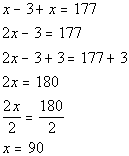
Example 2:  One number is 3 less than another number.  If the sum of the two numbers is 177, find each number.

 
Step 1: Understand the problem.

 
Make sure that you read the question carefully several times. 

We are looking for two numbers, and since we can write the one number in terms of another number, we will let

x = another number 

one number is 3 less than another number:

x - 3 = one number


 
Step 2:  Devise a plan (translate).


Step 3:  Carry out the plan (solve).


*Combine like terms

*Inv. of sub 3 is add 3

*Inv. of mult. 2 is div. 2


Step 4:  Look back (check and interpret).

 
If we add 90 and 87 (a number 3 less than 90) we do get 177.


FINAL ANSWER: 

One number is 90.

Another number is 87.


Rectangle Problem

 
The following formula will come in handy for solving example 3:

Perimeter of a rectangle = 2(length) + 2(width)


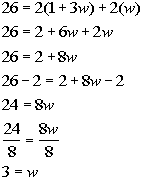
Example 3:  In a blueprint of a rectangular room, the length is 1 inch more than 3 times the width.  Find the dimensions if the perimeter is to be 26 inches.

 
Step 1: Understand the problem.

 
Make sure that you read the question carefully several times. 
 

We are looking for the length and width of the rectangle.  Since length can be written in terms of width, we will let

w = width

length is 1 inch more than 3 times the width:

1 + 3w = length


 
Step 2:  Devise a plan (translate).


Step 3:  Carry out the plan (solve).


*Remove ( ) by using dist. prop.
*Combine like terms

*Inv. of add. 2 is sub. 2

*Inv. of mult. by 8 is div. by 8


Step 4:  Look back (check and interpret).

 
If width is 3, then length, which is 1 inch more than 3 times the width would have to be 10.  The perimeter of a rectangle with width of 3 inches and length of 10 inches does come out to be 26.


FINAL ANSWER:

Width is 3 inches.

Length is 10 inches.


Supplementary and Complementary Angles

 
Supplementary angles sum up to be 180 degrees.

Complimentary angles sum up to be 90 degrees.


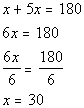
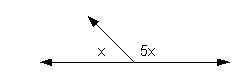
Example 4:  Find the measure of each angle in the figure below.  Note that since the angles make up a straight line, they are supplementary to each other.

 
Step 1: Understand the problem.

 
Make sure that you read the question carefully several times. 

We are already given in the figure that

x = 1 angle

5x = other angle


 
Step 2:  Devise a plan (translate).


Step 3:  Carry out the plan (solve).


*Combine like terms

*Inv. of mult. by 6 is div. by 6


Step 4:  Look back (check and interpret).

 
If x is 30, then 5x = 5(30) = 150.  150 and 30 do add up to be 180, so they are supplementary angles.

FINAL ANSWER:

The two angles are 30 degrees and 150 degrees.


Practice Problems

 
These are practice problems to help bring you to the next level.  It will allow you to check and see if you have an understanding of these types of problems. Math works just like anything else, if you want to get good at it, then you need to practice it.  Even the best athletes and musicians had help along the way and lots of practice, practice, practice, to get good at their sport or instrument.  In fact there is no such thing as too much practice.

To get the most out of these, you should work the problem out on your own and then check your answer by clicking on the link for the answer/discussion for that  problem.  At the link you will find the answer as well as any steps that went into finding that answer.


Practice Problems 1a - 1c: 

Solve the word problem.

 
1a.  The sum of a number and 2 is 6 less than twice that number.
(answer/discussion to 1a)

 
1b.  A rectangular garden has a width that is 8 feet less than twice the length.  Find the dimensions if the perimeter is 20 feet.
(answer/discussion to 1b)

 
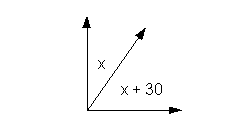
1c.  Complimentary angles sum up to be 90 degrees.  Find the measure of each angle in the figure below.  Note that since the angles make up a right angle, they are complementary to each other.

(answer/discussion to 1c)


Need Extra Help on These Topics?


The following are webpages that can assist you in the topics that were covered on this page: 
 
http://www.purplemath.com/modules/translat.htm
This webpage gives you the basics of problem solving and helps you with translating English into math.

http://www.math.com/school/subject2/lessons/S2U1L3DP.html
This webpage helps you with the basics of writing equations.

http://www.purplemath.com/modules/ageprobs.htm
This webpage goes through examples of age problems, which are like the numeric problems found on this page.


Go to Get Help Outside the Classroom found in Tutorial 1: How to Succeed in a Math Class for some more suggestions.


(Back to the Beginning Algebra Homepage)
(Back to the GRE Math Help Page)


All contents copyright (C) 2001 - 2008, WTAMU and Kim Seward. All rights reserved.
Last revised on June 22, 2003 by Kim Seward.