
 Learning Objectives
Introduction
In this tutorial we will be solving problems involving percentages. Since we are still problem solving, I will use Polya’s four steps to Problem Solving as introduced in Tutorial 15: Introduction to Problem Solving to step us through the percent problems in this tutorial. It is a good idea to be comfortable working with percents, you never know when you will be confronted with them. Let's see how we can help you out with percents.
Tutorial
% is the symbol that we use to notate percent.
Some examples of percentages are:
15% = 15/100 = .15
25% = 25/100 = .25
100% = 100/100 = 1.00
 Example
1: Write 57% as a decimal.
Example
1: Write 57% as a decimal.57% = . 57
Example
2: Write 145% as a decimal.145% = 1.45
Example
3: Write .34% as a decimal..34% = .0034
Writing a Decimal Number Example
4: Write .78 as a percent..78 = 78%
Example
5: Write 8 as a percent.8 = 800%
Example
6: Write .0325 as a percent..0325 = 3.25%
Step 1: Understand the problem.
Step 2: Devise a plan (translate).
Step 3: Carry out the plan (solve).
Step 4: Look back (check and interpret).
When you are looking for a percent, make sure that you convert your decimal into a percent, as shown above, for the final answer.
Example
7: Find 45% of 125. We are looking for a number that is 45% of 125, we will let
x = the value we are looking for


FINAL ANSWER:
Example
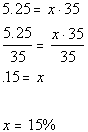
8: The number 5.25 is what percent of 35? We are looking for the percent we would have to take of 35 to get 5.25.
x = the percentage we are looking for

FINAL ANSWER:
Example
9: 32 is 40% of what number?We are looking for the number that you when you take 40% of it you would get 32.
x = the number we are looking for


FINAL ANSWER:
Example
10: A math class has 30 students. Approximately
70% passed their last math test. How many students passed the
last
math test?We are looking for how many students passed the last math test, we will let
x = number of students


FINAL ANSWER:
It is made up of a circle cut up in sectors. Each sector represents the percentage that a category of data is of the whole pie.
Keep in mind that a circle is 360 degrees.
The graph below is a pie chart:

Each sector of the circle represents the percentage of profits that the given ice cream flavor made.
The top sector shows that chocolate made 41% of the profits in 2002.
The bottom right sector shows that vanilla made 29% of the profits in 2002.
The bottom left sector shows that strawberry made 30% of
the profits
in 2002.
With all of this talk about pies and ice cream, is anyone else hungary????
Example
11: The pie chart or circle graph below shows the
total
enrollment of students at State College during the Fall 2002 semester,
broken down into seniors, juniors, sophomores, and freshmen. Use
the graph to answer questions 11a - 11c. 11a. In the Fall 2002 semester, what was the ratio of freshmen to seniors at the college?
11b. If the number of sophomores in the Fall 2002 semester was 20% higher than the number of sophomores in the Fall 2001 semester, how many sophomores were enrolled in Fall 2001?
11c. If the areas of sectors in the circle graphs
are drawn in
proportion to the percentages shown, what is the measure, in degrees,
of
the central angle sector representing the percentage of juniors?
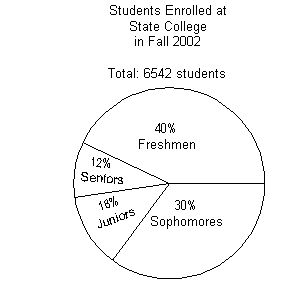
What do you think the first part of the ratio, freshmen or seniors? Since freshmen are listed first, that is what our first number of our ratio has to correspond to.
What is the percentage attached to freshmen? Looking on the pie chart, I believe it is 40%.
That leaves the number associated with seniors to be our second part of the ratio. Looks like that will be 12%.
So the ratio of freshman to seniors would be 40 to 12. You can think of ratios as fractions, and simplify them in the same manner. Since 40 and 12 have a greatest common factor of 4, we can reduce this to be 10 to 3.
Note that if you had started with 12 to 40, this would
be incorrect.
12 to 40 would be the ratio of seniors to freshman. You write a
ratio,
just like you read it, left to right.
The simplified ratio of freshmen to seniors would be 10 to 3.
What percentage were sophomores in the Fall 2002 semester? If you said 30% you are correct!!!
So what would be the number of sophomores for the Fall 2002 semester? When we take a percentage of a number, we write the percentage in decimal form and then multiply it times the number we are taking the percentage of.
Taking 30% of the total of 6542 we get:
(.3)(6542) = 1962.6 which rounds up to 1963.
1963 is the number of sophomores in the Fall 2002 semester.
Using this found information we need to find out how many sophomores were enrolled in the Fall 2001 semester.
The problem says that the Fall 2002 semester has 20% more sophomores than the Fall 2001 semester.
We are going to let x be the number of sophomores in Fall 2001.
We are needing an equation that represents the English phrase "the Fall 2002 semester has 20% more sophomores than the Fall 2001 semester". Going left to right, the Fall 2002 semester would be 1963, has would be our = sign, 20% more than the Fall 2001 semester, would be starting with the Fall 2001 semester, which is x and adding on 20% of that, which is .2x. From all of this we get the following equation:

Solving this equation for x we get:
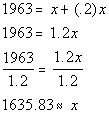
*Divide both sides by 1.2
What percentage of the students were juniors in the Fall 2002 semester? If you said 18% you are correct!!!
So what would be the measure of the central angle for
juniors for
the Fall 2002 semester?
Since a full circle is 360 degrees, we are basically wanting
to know what 18% of 360 degrees is.
As shown above, when we take a percentage of a number, we write the percent in decimal form and then multiply it times the number we are taking the percentage of.
Taking 18% of the total of 360 degrees we get:
(.18)(360degrees) = 64.8 degrees
The central angle sector for the juniors measures 64.8 degrees.
A table can have one, two, three or more columns of
data.
The graph below is a table:
Yummy Ice Cream Profits
The first column identifies the flavors of ice cream that made a profit.
The second column represents the percentage of profits that each flavor made in 2001 as well as the total profits in dollars.
The third column represents the percentage of profits that each flavor made in 2002 as well as the total profits in dollars.
Vanilla made 35.3% of the profits in 2001 and 29% of the profits in 2002.
Chocolate made 40% of the profits in 2001 and 41% of the profits in 2002.
Strawberry made 24.7% of the profits in 2001 and 30% of the profits in 2002.
Example
12: The table below shows the results of a survey on
beverage
preference taken with customers of the Good Eats Café in 2001
and
2002. Each customer voted for only one beverage. Use the
table
to answer questions 12a - 12c. 12a. Approximately how many customers preferred Sprite in 2002?
12b. By approximately what percent did the preference of root beer decrease from 2001 to 2002?
12c. What was the difference between the number of votes for Coca Cola in 2001 versus 2002?
Survey of Customer’s Beverage Preference at the Good
Eats Café.
Each customer voted for only one beverage.
What percent of customers in 2002 voted for Sprite? Looking at the third column (2002), it looks like it is 14.4%.
How many votes were taken in 2002? Looking at the bottom of the third column (2002), it says that the total number of votes in 2002 is 9432.
When we take a percentage of a number, we write
the percentage in decimal form and then multiply it times the
number
we are taking the percentage of.
Taking 14.4% of the total of 9432 we get:
(.144)(9432) = 1358.208 which rounds down to 1358.
Approximately 1358 customers voted for Sprite in 2002.
What was the percent of customers that voted for root beer in 2001? If you said 2.7, you are correct. You find that by going to the second column (2001) and going down to root beer.
What was the percent of customers that voted for root beer in 2002? If you said 1.1, you are correct. You find that by going to the third column (2002) and going down to root beer.
So what is their difference? 2.7 - 1.1 = 1.6
There was a 1.6% decrease of votes for root beer from 2001 to 2002.
What percent of customers in 2001 voted for Coca Cola? Looking at the second column (2001), it looks like it is 35%.
How many votes were taken in 2001? Looking at the bottom of the second column (2001), it says that the total number of votes in 2001 is 8950.
When we take a percentage of a number, we write the percentage in decimal form and then multiply it times the number we are taking the percentage of.
Taking 35% of the total of 8950 we get:
(.35)(8950) = 3132.5 which rounds up to 3133.
Approximately 3133 customers voted for Coca Cola in
2001.
What percent of customers in 2002 voted for Coca Cola? Looking at the third column (2002), it looks like it is 30%.
How many votes were taken in 2002? Looking at the bottom of the third column (2002), it says that the total number of votes in 2002 is 9432.
When we take a percentage of a number, we write the percentage in decimal form and then multiply it times the number we are taking the percentage of.
Taking 30% of the total of 9432 we get:
Approximately 2830 customers voted for Coca Cola in
2002.
Finding the difference between the two values that we found we get:
3133 - 2830 = 303
There was a 303 difference between the number of customers that voted for Coca Cola in 2001 versus 2002.
Practice Problems
To get the most out of these, you should work the problem out on your own and then check your answer by clicking on the link for the answer/discussion for that problem. At the link you will find the answer as well as any steps that went into finding that answer.
Practice Problems 1a - 1b: Write each percent as a decimal.
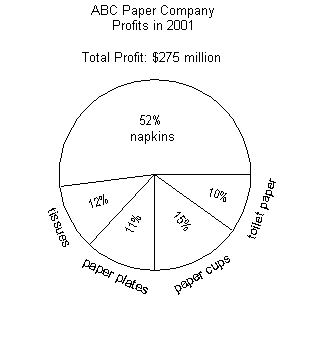
Use the graph to answer questions 4a - 4c.
Need Extra Help on these Topics?
http://www.purplemath.com/modules/percents.htm
This webpage goes over percentages.
Go to Get Help Outside the Classroom found in Tutorial 1: How to Succeed in a Math Class for some more suggestions.

Last revised on July 27, 2011 by Kim Seward.
All contents copyright (C) 2001 - 2010, WTAMU and Kim Seward. All rights reserved.