College Algebra
Answer/Discussion to Practice Problems
Tutorial 44: Logarithmic Properties
 Answer/Discussion
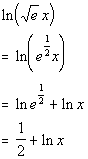
to 1a Answer/Discussion
to 1a

|
What is the base in this problem?
This time the base is e. Make sure
that you keep that same base throughout the problem. |
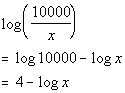
Answer/Discussion
to 1b

|
What is the base in this problem?
This time the base is 10. Make sure that you keep that same base
throughout the problem. |
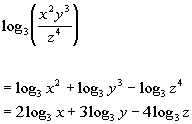
Answer/Discussion
to 1c

|
What is the base in this problem?
This time the base is 3. Make sure that you keep that same base
throughout the problem. |
Answer/Discussion
to 2a

|
What is the base in this problem?
This time the base is 10. Make sure that you keep that same base
throughout the problem. |
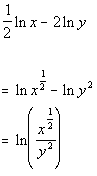
Answer/Discussion
to 2b

|
What is the base in this problem?
This time the base is e. Make sure
that you keep that same base throughout the problem. |
Answer/Discussion
to 3a

|
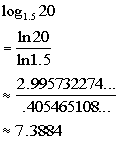
Note that the calculator can only evaluate logs that are base 10 or
base e. Since this problem is in base
1.5, we need to change the base to base e (or base 10). Since the instructions say base e,
let's do that. |
|
*Use the calculator to find ln 20 and ln 1.5
*Divide |

Last revised on March 23, 2011 by Kim Seward.
All contents copyright (C) 2002 - 2011, WTAMU and Kim Seward. All rights reserved.