VML banner
wt linkvml linkcollege algebra linkintermediate algebrabeginning algebra linkgre linkthea link

College Algebra
Answer/Discussion to Practice Problems  
Tutorial 17: Quadratic Equations


WTAMU > Virtual Math Lab > College Algebra > Tutorial 17: Quadratic Equations


Answer/Discussion to 1a


Step 1: Simplify each side if needed.

 
This quadratic equation is already simplified.

 
Step 2: Write in standard form, , if needed.

 
This quadratic equation is already in standard form.

 
Step 3: Factor.

 
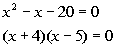
*Quad. eq. in standard form
*Factor the trinomial

 
Step 4:  Use the Zero-Product Principle

AND

Step 5: Solve for the linear equation(s) set up in step 4. 
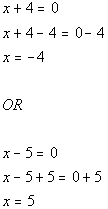

 
*Use Zero-Product Principle
*Solve the first linear equation


*Solve the second linear equation


There are two solutions to this quadratic equation: x = -4 and x = 5.

 
(return to problem 1a)


Answer/Discussion to 1b


Step 1: Simplify each side if needed.

 
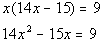
*Use Dist. Prop. to clear the (  )

 
Step 2: Write in standard form, , if needed.


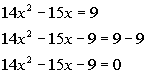
*Inverse of add. 9 is sub. 9
*Quad. eq. in standard form

 
Step 3: Factor.

 
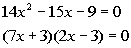
*Quad. eq. in standard form
*Factor the trinomial

 
Step 4:  Use the Zero-Product Principle

AND

Step 5: Solve for the linear equation(s) set up in step 4. 
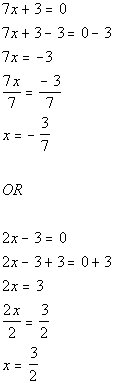

 
*Use Zero-Product Principle
*Solve the first linear equation


*Solve the second linear equation


There are two solutions to this quadratic equation: x = -3/7 and x = 3/2.

 
(return to problem 1b)


Answer/Discussion to 2a


Step 1: Write the quadratic equation in the form  if needed

AND

Step 2: Apply the square root method.


Note how this quadratic equation is not in the form  to begin with.  The 3 is NOT part of the expression being squared on the left side of the equation.  We can easily write it in the form  by dividing both sides by 3.
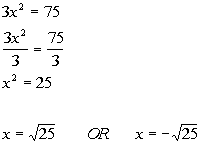
 
*Not in the form 
*Inv. of mult. by 3 is div. by 3

*Written in the form 

*Apply the sq. root method
*There are 2 solutions
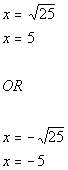

 
Step 3: Solve for the linear equation(s) set up in step 2. 

 
*Sq. root of 25 = 5


*Neg. sq. root of 25 = -5


There are two solutions to this quadratic equation: x = 5 and x = -5.

 
(return to problem 2a)


Answer/Discussion to 2b


Step 1: Write the quadratic equation in the form  if needed

AND

Step 2: Apply the square root method.
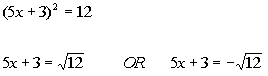

 
*Written in the form 

*Apply the sq. root method
*There are 2 solutions
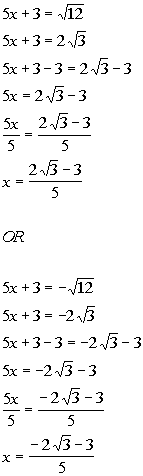

 
Step 3: Solve for the linear equation(s) set up in step 2. 

 
*Sq. root of 12 = 2 sq. root of 3
*Solve for x


*Neg. sq. root of 12 = -2 sq. root of 3
*Solve for x


There are two solutions to this quadratic equation: x   and x .

 
(return to problem 2b)


Answer/Discussion to 3a


Step 1: Make sure that the coefficient on the  term is equal to 1.

 
The coefficient of the  term is already 1.

 
Step 2:  Isolate the  and x terms.

 
Note how the  and x terms are not isolated to begin with.  We can easily fix that by moving the constant to the other side of the equation.
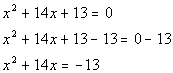
 
*Inverse of add. 13 is sub. 13

* and x terms are now isolated


Step 3:  Complete the square.

 
*b is the coefficient of the x term

*Complete the square by taking 1/2 of b and squaring it
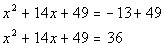


*Add constant found above to BOTH sides of the eq.

*This creates a PST on the left side of eq. 
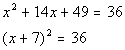

 
Step 4Factor the perfect square trinomial (created in step 3) as a binomial squared.


*Factor the PST

 
Step 5:  Solve the equation in step 4 by using the square root method.

 
*Written in the form 
*Apply the sq. root method
*There are 2 solutions


There are two solutions to this quadratic equation: x = -1  and x = -13.

 
(return to problem 3a)


Answer/Discussion to 3b


Step 1Make sure that the coefficient on the  term is equal to 1.

 
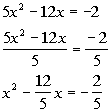
Note how the coefficient on the  term is not 1 to begin with.  We can easily fix that by dividing both sides by that coefficient, which in this case is 5 .


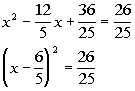
*Divide both sides by 5
 

*Coefficient of  term is now 1


Step 2:  Isolate the  and x terms.

 
The  and x terms are already isolated.

 
Step 3:  Complete the square.

 
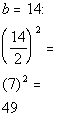
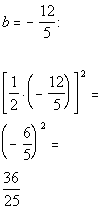
*b is the coefficient of the x term


*Complete the square by taking 1/2 of b and squaring it


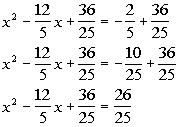
*Add constant found above to BOTH sides of the eq.


*This creates a PST on the left side of eq. 
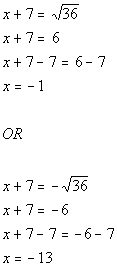


Step 4Factor the perfect square trinomial (created in step 3) as a binomial squared.


*Factor the PST

 
Step 5:  Solve the equation in step 4 by using the square root method.

 
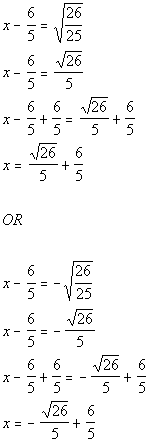
*Written in the form 
*Apply the sq. root method
*There are 2 solutions


There are two solutions to this quadratic equation:  x   and x .

 
(return to problem 3b)


Answer/Discussion to 4a


Step 1: Simplify each side if needed.

 
This quadratic equation is already simplified.

 
Step 2: Write in standard form, , if needed.

 
This quadratic equation is already in standard form.

 
Step 3: Identify a, b, and c.

 
a, the number in front of x squared, is 1.

b, the number in front of x, is 10. 

c, the constant, is 25.
 

Make sure that you keep the sign that is in front of each of these numbers. 

Next we will plug it into the quadratic formula.   Note that we are only plugging in numbers, we don't also plug in the variable.


Step 4: Plug the values found in step 3 into the quadratic formula

AND

Step 5: Simplify if possible. 


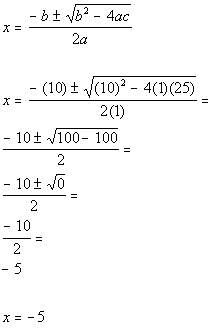
*Quadratic formula


*Plug in values found above for a, b, and c

*Simplify 


(return to problem 4a)


Answer/Discussion to 4b


Step 1: Simplify each side if needed.

 
This quadratic equation is already simplified.

 
Step 2: Write in standard form  if needed.

 
This quadratic equation is already in standard form.

 
Step 3: Identify a, b, and c.

 
a, the number in front of x squared, is 5.

b, the number in front of x, is 2. 

c, the constant, is 10.
 

Make sure that you keep the sign that is in front of each of these numbers. 

Next we will plug it into the quadratic formula.   Note that we are only plugging in numbers, we don't also plug in the variable.


Step 4: Plug the values found in step 3 into the quadratic formula

AND

Step 5: Simplify if possible. 


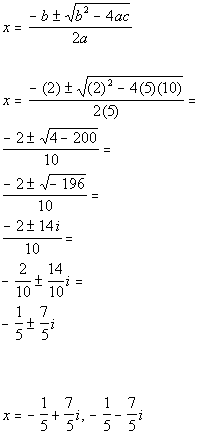
*Quadratic formula


*Plug in values found above for a, b, and c

*Simplify 


*Square root of a negative 1 is i


(return to problem 4b)


Answer/Discussion to 4c


Step 1: Simplify each side if needed.

 
This quadratic equation is already simplified.

 
Step 2: Write in standard form  if needed.


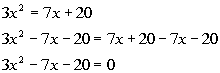
*Inverse of add. 7x and 20 is sub. 7x and 20

*Quad. eq. in standard form


Step 3: Identify a, b, and c.

 
a, the number in front of x squared, is 3.

b, the number in front of x, is -7. 

c, the constant, is -20.
 

Make sure that you keep the sign that is in front of each of these numbers. 

Next we will plug it into the quadratic formula.   Note that we are only plugging in numbers, we don't also plug in the variable.


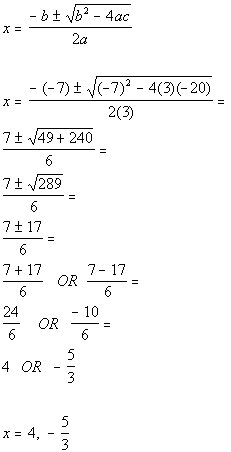
Step 4: Plug the values found in step 3 into the quadratic formula

AND

Step 5: Simplify if possible. 


*Quadratic formula


*Plug in values found above for a, b, and c

*Simplify 


(return to problem 4c)


Answer/Discussion to 5a


Step 1: Simplify each side if needed.

 
This quadratic equation is already simplified.

 
Step 2: Write in standard form, , if needed.

 
This quadratic equation is already in standard form.

 
Step 3: Identify a, b, and c.

 
a, the number in front of x squared, is 1.

b, the number in front of x, is -12.

c, the constant, is 36.
 

Make sure that you keep the sign that is in front of each of these numbers. 


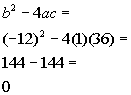
Step 4: Plug the values found in step 3 into the discriminant, ,

AND

Step 5: Simplify if possible. 


*Discriminant formula

*Plug in values found above for a, b, and c

*Discriminant


Since the discriminant is zero, that means there is only one real number solution.

 
(return to problem 5a)


Answer/Discussion to 5b


Step 1: Simplify each side if needed.

 
This quadratic equation is already simplified.

 
Step 2: Write in standard form, , if needed.


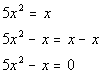
*Inverse of add. x is sub. x

*Quad. eq. in standard form


Step 3: Identify a, b, and c.

 
a, the number in front of x squared, is 5.

b, the number in front of x, is -1.

c, the constant, is 0.
Note that since the constant is missing it is understood to be 0.
 

Make sure that you keep the sign that is in front of each of these numbers. 


Step 4: Plug the values found in step 3 into the discriminant, ,

AND

Step 5: Simplify if possible. 


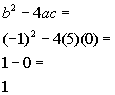
*Discriminant formula

*Plug in values found above for a, b, and c

*Discriminant


Since the discriminant is a positive number, that means there are two distinct real number solutions.

 
(return to problem 5b)


Answer/Discussion to 5c


Step 1: Simplify each side if needed.

 
This quadratic equation is already simplified.

 
Step 2: Write in standard form, , if needed.


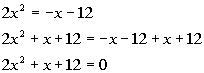
*Inverse of sub. x and 12 is add. x and 12

*Quad. eq. in standard form


Step 3: Identify a, b, and c.

 
a, the number in front of x squared, is 2.

b, the number in front of x, is 1.

c, the constant, is 12.
 

Make sure that you keep the sign that is in front of each of these numbers. 


Step 4: Plug the values found in step 3 into the discriminant, ,

AND

Step 5: Simplify if possible. 


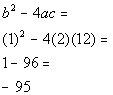
*Discriminant formula

*Plug in values found above for a, b, and c

*Discriminant


Since the discriminant is a negative number, that means there are two distinct complex imaginary solutions.

 
(return to problem 5c)


WTAMU > Virtual Math Lab > College Algebra > Tutorial 17: Quadratic Equations


All contents copyright (C) 2002 - 2008, WTAMU and Kim Seward. All rights reserved.
Last revised on June, 2008 by Kim Seward.