VML banner
wt linkvml linkcollege algebra linkintermediate algebrabeginning algebra linkgre linkthea link

College Algebra
Tutorial 12: Complex Numbers


WTAMU > Virtual Math Lab > College Algebra


deskLearning Objectives


After completing this tutorial, you should be able to:
  1. Take the principle square root of a negative number.
  2. Write a complex number in standard form.
  3. Add and subtract complex numbers.
  4. Multiply complex numbers.
  5. Divide complex numbers.


desk Introduction   


In this tutorial we will be looking at imaginary and complex numbers.  Imaginary numbers allow us to take the square root of negative numbers.  I will take you through adding, subtracting, multiplying and dividing complex numbers as well as finding the principle square root of negative numbers.  I do believe that you are ready to get acquainted with imaginary and complex numbers.


desk Tutorial


 Imaginary Unit

   where


This is the definition of an imaginary number.

From here on out, anytime that you have the square root of -1 you can simplify it as i and anytime you have  you can simplify it as -1.


 Standard Form
of
Complex Numbers


Complex numbers are made up of a real number part and an imaginary number part. 

In this form, a is the real number part and b is the imaginary number part.

Note that either one of these parts can be 0.

An example of a complex number written in standard form is

.


 Equality
of
Complex Numbers

if and only if a = c AND b = d.


In other words, two complex numbers are equal to each other if their real numbers match AND their imaginary numbers match.


 Addition and Subtraction of 
Complex Numbers


In other words, when you add or subtract two complex numbers together, you add or subtract the real number parts together, then add or subtract their imaginary parts together and write it as a complex number in standard form.


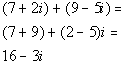
notebook Example 1: Add .

videoView a video of this example


*Add the real num. together and the imaginary num. together
*Complex num. in stand. form


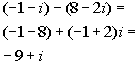
notebook Example 2: Subtract .

videoView a video of this example


*Subtract the real num. together and the imaginary num. together
*Complex num. in stand. form


 Multiplying 
Complex Numbers

 
Step 1:  Multiply the complex numbers in the same manner as polynomials.

 
If you need a review on multiplying polynomials, go to Tutorial 6: Polynomials.


Step 2:  Simplify the expression.

 
Add real numbers together and imaginary numbers together.

Whenever you have an , use the definition and replace it with -1.


Step 3:  Write the final answer in standard form.


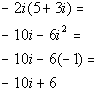
notebook Example 3: Multiply .

videoView a video of this example


Step 1:  Multiply the complex numbers in the same manner as polynomials

AND

Step 2:  Simplify the expression.


*Use dist. prop. to multiply

*i squared = -1


Step 3:  Write the final answer in standard form.


*Complex num. in stand. form


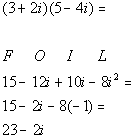
notebook Example 4: Multiply .

videoView a video of this example


Step 1:  Multiply the complex numbers in the same manner as polynomials

AND

Step 2:  Simplify the expression.


*Use FOIL method to multiply

*Combine imaginary numbers
*i squared = -1


Step 3:  Write the final answer in standard form.


*Complex num. in stand. form


 Dividing 
Complex Numbers


Step 1:  Find the conjugate of the denominator.

 
You find the conjugate of a binomial by changing the sign that is between the two terms, but keep the same order of the terms. 

a + bi and a - bi are conjugates of each other.


Step 2:  Multiply the numerator and the denominator of the fraction by the conjugate found in Step 1.

 
Keep in mind that as long as you multiply the numerator and denominator by the exact same thing, the fractions will be equivalent. 

When you multiply complex conjugates together you get: 



Step 3:  Simplify the expression.

 
Add real numbers together and imaginary numbers together.

Whenever you have an , use the definition and replace it with -1.


Step 4:  Write the final answer in standard form.


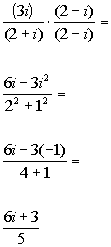
notebook Example 5: Divide .

videoView a video of this example


Step 1:  Find the conjugate of the denominator.

 
In general the conjugate of a + bi is a - bi and vice versa. 

So what would the conjugate of our denominator be? 

It looks like the conjugate is .


Step 2:  Multiply the numerator and the denominator of the fraction by the conjugate found in Step 1

AND

Step 3:  Simplify the expression.


*Multiply top and bottom by conj. of den.


*
 

*i squared = -1


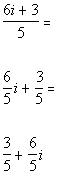
Step 4:  Write the final answer in standard form.


*Divide each term of num. by 5


*Complex num. in stand. form


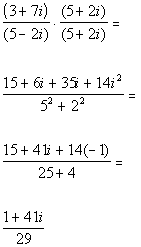
notebook Example 6: Divide .

videoView a video of this example


Step 1:  Find the conjugate of the denominator.

 
In general the conjugate of a + bi is a - bi and vice versa. 

So what would the conjugate of our denominator be? 

It looks like the conjugate is .


Step 2:  Multiply the numerator and the denominator of the fraction by the conjugate found in Step 1

AND

Step 3:  Simplify the expression.


*Multiply top and bottom by conj. of den.


*
 

*i squared = -1


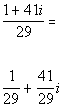
Step 4:  Write the final answer in standard form.

 
*Divide each term of num. by 29

*Complex num. in stand. form


 Principal Square Root 
of a Negative Number
 

For any positive real number b, the principal square root of the negative number, -b, is defined by


notebook Example 7: Simplify .

videoView a video of this example


*Principal square root of -100

*Complex num. in stand. form (note real num. part is 0)


 Working problems with square roots of 
negative numbers.

 
Step 1:  Express the square root of any negative number in terms of i.

 
In other words use the definition of principal square roots of negative numbers before performing any operations.


Step 2:  Perform the indicated operation.


Step 3:  Write the final answer in standard form.


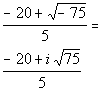
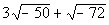
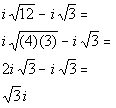
notebook Example 8: Perform the indicated operation.  Write answer in standard form.

videoView a video of this example


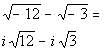
Step 1:  Express the square root of any negative number in terms of i.


*Square root of a negative is i

 
Step 2:  Perform the indicated operation

AND

Step 3:  Write the final answer in standard form.


*Rewrite 12 as (4)(3)

*The square root of 4 is 2
*Subtract like radicals: 2i- i = i
*Complex num. in stand. form (note real num. part is 0)


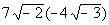
notebook Example 9: Perform the indicated operation.  Write answer in standard form.
videoView a video of this example


Step 1:  Express the square root of any negative number in terms of i.


*Square root of a negative is i

 
Step 2:  Perform the indicated operation

AND

Step 3:  Write the final answer in standard form.


*Square the binomial

*i squared = -1

*Complex num. in stand. form


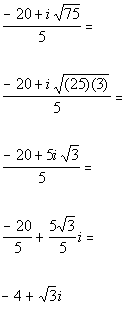
notebook Example 10: Perform the indicated operation.  Write answer in standard form.

videoView a video of this example


Step 1:  Express the square root of any negative number in terms of i.


*Square root of a negative is i

 
Step 2:  Perform the indicated operation

AND

Step 3:  Write the final answer in standard form.


*Rewrite 75 as (25)(3) 


*The square root of 25 is 5


*Divide each term of num. by 5


*Complex num. in stand. form


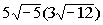
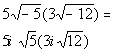
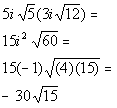
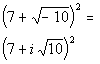
notebookExample 11: Perform the indicated operation.  Write answer in standard form.
videoView a video of this example


Step 1:  Express the square root of any negative number in terms of i.


*Square root of a negative is i

 
Step 2: Perform the indicated operation

AND

Step 3:  Write the final answer in standard form.
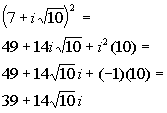

 
*i squared = -1
*Rewrite 60 as (4)(15)
*The square root of 4 is 2
*Complex num. in stand. form (note that the imaginary part is 0)


desk Practice Problems


These are practice problems to help bring you to the next level.  It will allow you to check and see if you have an understanding of these types of problems. Math works just like anything else, if you want to get good at it, then you need to practice it.  Even the best athletes and musicians had help along the way and lots of practice, practice, practice, to get good at their sport or instrument.  In fact there is no such thing as too much practice.

To get the most out of these, you should work the problem out on your own and then check your answer by clicking on the link for the answer/discussion for that  problem.  At the link you will find the answer as well as any steps that went into finding that answer.


pencil Practice Problems 1a - 1i: Perform the indicated operation. Write the answer in standard form.
 

1a. 
(answer/discussion to 1a)
1b. 
(answer/discussion to 1b)
1c. 
(answer/discussion to 1c)

 
1d. 
(answer/discussion to 1d)
1e. 
(answer/discussion to 1e)
1f. 
(answer/discussion to 1f)

 
1g. 
(answer/discussion to 1g)
1h. 
(answer/discussion to 1h)
1i. 
(answer/discussion to 1i)


desk Need Extra Help on these Topics?


No appropriate web pages could be found to help you with the topics on this page.
 

Go to Get Help Outside the Classroom found in Tutorial 1: How to Succeed in a Math Class for some more suggestions.


WTAMU > Virtual Math Lab > College Algebra


All contents copyright (C) 2002, WTAMU and Kim Peppard. All rights reserved.
Videos at this site were created and produced by Kim Peppard and Virginia Williams.
Last revised on May 16, 2008 by Kim Peppard.