Answer/Discussion
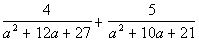
to 1a

|
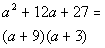
| The first denominator has the following two factors: |
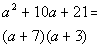
| The second denominator has the following two factors: |
| Putting all the different factors together and using the highest
exponent, we get the following LCD: |
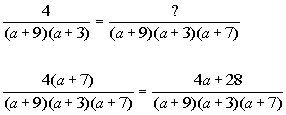
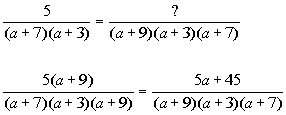
| Rewriting the first expression with the LCD: |
 |
*Missing the factor of (a
+
7) in the den.
*Mult. top and bottom by (a
+
7)
|
| Rewriting the second expression with the LCD: |
 |
*Missing the factor of (a
+
9) in the den.
*Mult. top and bottom by (a
+
9)
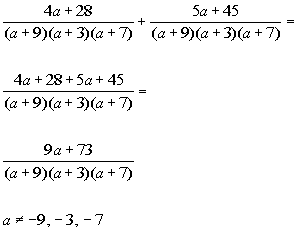
|
 |
*Combine the numerators
*Write over common denominator
|
| Step 4: Reduce
to lowest terms. |
| This rational expression cannot be simplified down any farther. |
| Also note that the values that would be excluded from the domain
are -9, -3 and -7. These are the values that make the original
denominator equal to 0. |
Answer/Discussion
to 1b

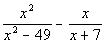
|
| The first denominator has the following two factors: |
| The second denominator has the following factor: |
| Putting all the different factors together and using the highest
exponent, we get the following LCD: |
| Since the first rational expression already has the LCD, we
do not need to change this fraction. |
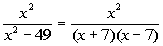
 |
*Rewriting denominator in factored form
|
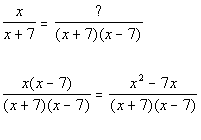
| Rewriting the second expression with the LCD: |
 |
*Missing the factor of (x
-
7) in the den.
*Mult. top and bottom by (x
-
7)
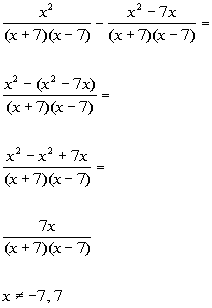
|
 |
*Combine the numerators
*Write over common denominator
*Distribute the minus sign through the (
)
|
| Step 4: Reduce
to lowest terms. |
| This rational expression cannot be simplified down any farther. |
| Also note that the values that would be excluded from the domain
are -7 and 7. These are the values that make the original
denominator equal to 0. |
WTAMU > Virtual Math Lab > College Algebra > Tutorial 10: Adding and Subtracting Rational Expressions
All contents copyright (C) 2002 - 2008, WTAMU and Kim Seward. All rights reserved.
Last revised on April 2, 2008 by Kim Seward.
|