
 Learning Objectives
Special Notes about Tutorial 42:
Introduction
Also note that your teacher may word the problems on
their test a
little differently, may have some different kinds of problems, or may
have
a different number of problems than what is in this practice test.
Again, since I'm probably not your math instructor, I don't know
exactly
how your teacher will set up your math test. Just note that these
problems will help you build an understanding of the concepts presented
and the terms used in math problems. If you have an
understanding
of the problems instead of just memorizing them, then you should do
fine
on these concepts, no matter how the test is set up.
It is to your benefit to show as much of the work as possible on the problems that have several steps involved.
Make sure that you read the directions carefully, you wouldn't believe how many points get taken off math tests for people not following directions.
Pace yourself. You do not have to be the first one done to do well on the test. Do not panic if there is still time left to take the test and others are turing it in. Sometimes that means they do not know the material and left some of the answers blank. Do not worry about anyone else but yourself.
Don't rush through a problem. Another thing that math teachers take points off for are careless mistakes made by people that rush through a problem. When those students get their tests back, they bonk themselves on the head at some of the things that got counted wrong, things that they knew how to do.
Check your answers. If you have time, go back and check your answers.
Remember to breathe!!!! I know some of you are scared to death at the thought of having to take a math test of any kind. For you guys, try to relax and don't forget to breathe. (Even if you aren't scared to take a math test, it is probably a good idea to remember to breathe, I wouldn't want you to pass out during the test). If it feels like your brain has left the building during your test, just close your eyes and breathe in and out and in and out and your brain will return.
Good luck on your test. If you are taking a math test soon, don't panic, you are going to do great!!!
Practice Test


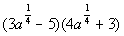
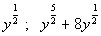


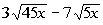
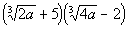


Need Extra Help on these Topics?
Tutorial 38: Rational Exponents
This tutorial will help you with problems 3a - 3b, 4a, 5a - 5b, 6a and 7a on this practice
test.
Tutorial 39: Simplifying Radical
Expressions
This tutorial will help you with problems 8a, 9a, 10a - 10b, 11a on this practice test.
Tutorial 40: Adding, Subtracting
and Multiplying Radicals
This tutorial will help you with problems 12a and 13a on this practice test.
Tutorial 41: Rationalizing
Denominators and Numerators of Radical Expressions
This tutorial will help you with problems 14a - 14b and 15a on this practice test.
Go to Get Help Outside the Classroom found in Tutorial 1: How to Succeed in a Math Class for some more suggestions.

Last revised on July 21, 2011 by Kim Seward.
All contents copyright (C) 2001 - 2011, WTAMU and Kim Seward.
All rights reserved.