
 Learning Objectives
Introduction
When solving linear inequalities, we use a lot of the same concepts that we use when solving linear equations. Basically, we still want to get the variable on one side and everything else on the other side by using inverse operations. The difference is, when a variable is set equal to one number, that number is the only solution. But, when a variable is less than or greater than a number, there are an infinite number of values that would be a part of the answer. I think you are ready to get going on this tutorial.
Tutorial
a < b a is less than b
a < b a is less than or equal to b
a > b a is greater than b
a > b a is
greater than or equal to b
Interval Notation
Note that in the interval notations (found below), you will see the
symbol  , which
means infinity.
, which
means infinity.
)
means it goes on and on indefinitely to the right of the number - there
is no endpoint on the right.
Negative infinity (-)
means it goes on and on indefinitely to the left of the number - there
is no endpoint to the left.
Since we don't know what the largest or smallest numbers are, we need to use infinity or negative infinity to indicate there is no endpoint in one direction or the other.
In general, when using interval notation, you always put the smaller value of the interval first (on the left side), put a comma between the two ends, then put the larger value of the interval (on the right side). You will either use a curved end ( or ) or a boxed end [ or ], depending on the type of interval (described below).
If you have either infinity or negative infinity on either end, you
always use a curve for that end. This will indicate that there is no definite
endpoint in that direction, it keeps going and going.
Open Interval
To indicate this, we use a curved end as shown below.
x > 4
x < 4
) , a)
(4, )
(-, 4)
Closed Interval
To indicate this, we use a boxed end as shown below.
As mentioned above, even though a is included
and has a boxed end, if it goes to either infinity or negative infinity
on the other end, we will notate it with a curved end for that end only!
x > 4
x < 4
) , a]
[4, )
(-, 4]
Addition/Subtraction Property for Inequalities
If a < b, then a + c < b + c
If a < b, then a - c < b - c
 Example
1: Solve, write your answer in interval notation and graph
the solution set.
Example
1: Solve, write your answer in interval notation and graph
the solution set. 
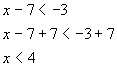
Interval notation: (-,
4)
Graph:
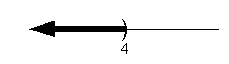
*Open interval indicating all values less than 4
*Visual showing all numbers less than 4 on the number line
The answer 'x is less than 4' means that if we put any number less than 4 back in the original problem, it would be a solution (the left side would be less than the right side). As mentioned above, this means that we have more than just one number for our solution, there are an infinite number of values that would satisfy this inequality.
Interval notation:
We have an open interval since we are not including where it is equal
to 4. x is less than 4, so
4 is the largest value of the interval, so it goes on the right.
Since there is no lower endpoint (it is ALL values less than 4), we put
the negative infinity symbol on the left side. The curved end on
4 indicates an open interval. Negative infinity always has a curved
end because there is not an endpoint on that side.
Graph:
We use the same type of notation on the endpoint as we did in the interval
notation, a curved end. Since we needed to indicate all values
less than 4, the part of the number line that was to the left of 4 was
darkened.
Example
2: Solve, write your answer in interval notation and graph the
solution set. 
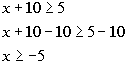
Interval notation: [-5, )
Graph:
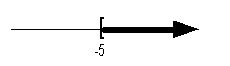
*Closed interval indicating all values greater than or = -5
*Visual showing all numbers greater than or = to -5 on the number line.
The answer 'x is greater than or equal to -5' means that if we put any number greater than or equal to -5 back in the original problem, it would be a solution (the left side would be greater than or equal to the right side). As mentioned above, this means that we have more than just one number for our solution, there are an infinite number of values that would satisfy this inequality.
Interval notation:
We have a closed interval since there we are including where it is
equal to -5. x is greater than
or equal to -5, so -5 is our smallest value of the interval, so it goes
on the left. Since there is no upper endpoint (it is ALL values greater
than or equal to -5), we put the infinity symbol on the right side.
The boxed end on -5 indicates a closed interval. Infinity always
has a curved end because there is not an endpoint on that side.
Graph:
We use the same type of notation on the endpoint as we did in the interval
notation, a boxed end. Since we needed to indicate all
values greater than or equal to -5, the part of the number line that was
to the right of -5 was darkened.
Multiplication/Division Properties for Inequalities
when multiplying/dividing by a positive value
If a < b AND c is positive, then ac < bc
If a < b AND c is positive, then
a/c < b/c
Example
3: Solve, write your answer in interval notation and graph
the solution set. 

Interval notation: (-,
-2)
Graph:
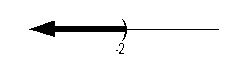
*Open interval indicating all values less than -2
*Visual showing all numbers less than -2 on
the number line
Interval notation:
We have an open interval since there we are not including where it
is equal to -2. x is less than
-2, so -2 is our largest value of the interval, so it goes on the right.
Since there is no lower endpoint (it is ALL values less than -2), we put
the negative infinity symbol on the left side. The curved end on
-2 indicates an open interval. Negative infinity always has a curved
end because there is not an endpoint on that side.
Graph:
We use the same type of notation on the endpoint as we did in the interval
notation, a curved end. Since we needed to indicate all values
less than -2, the part of the number line that was to the left of -2 was
darkened.
Example
4: Solve, write your answer in interval notation and graph
the solution set. 
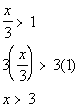
Interval notation: (3, )
Graph:
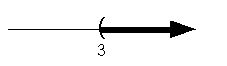
*Open interval indicating all values greater than 3
*Visual showing all numbers greater than 3
on the number line
Interval notation:
We have an open interval since there we are not including where it
is equal to 3. x is greater than
3, so 3 is our smallest value of the interval so it goes on the left.
Since there is no upper endpoint (it is ALL values less than 3) we put
the infinity symbol on the right side. The curved end on 3 indicates
an open interval. Infinity always has a curved end because there
is not an endpoint on that side.
Graph:
We use the same type of notation on the endpoint as we did in the interval
notation, a curved end. Since we needed to indicate all values
greater than 3, the part of the number line that was to the right of 3
was darkened.
Multiplication/Division Properties for Inequalities
when multiplying/dividing by a negative value
If a < b AND c is negative, then ac > bc
If a < b AND c is negative, then
a/c > b/c
The reason for this is, when you multiply or divide an expression by
a negative number, it changes the sign of that expression. On the
number line, the positive values go in a reverse or opposite direction
than the negative numbers go, so when we take the opposite of an expression,
we need to reverse our inequality to indicate this.
Example
5: Solve, write your answer in interval notation and graph
the solution set. 
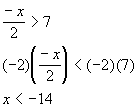
Interval notation: (- ,
-14)
Graph:
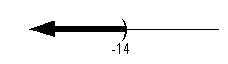
*Open interval indicating all values less than -14
*Visual showing all numbers less than -14 on
the number line
In line 2, note that when I did show the step of multiplying both sides by a -2, I reversed my inequality sign.
Interval notation:
We have an open interval since there we are not including where it
is equal to -14. x is less than
-14, so -14 is our largest value of the interval, so it goes on the right.
Since there is no lower endpoint (it is ALL values less than -14), we put
the negative infinity symbol on the left side. The curved end on
-14 indicates an open interval. Negative infinity always has a curved
end because there is not an endpoint on that side.
Graph:
We use the same type of notation on the endpoint as we did in the interval
notation, a curved end. Since we needed to indicate all values
less than -14, the part of the number line that was to the left of -14
was darkened.
Example
6: Solve, write your answer in interval notation and graph
the solution set. 

Interval notation: [-3, )
Graph:
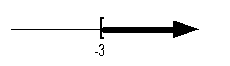
*Closed interval indicating all values greater than or = -3
*Visual showing all numbers greater than or
= -3 on the number line
Interval notation:
We have a closed interval since there we are including where it is
equal to -3. x is greater than
or equal to -3, so -3 is our smallest value of the interval so it goes
on the left. Since there is no upper endpoint (it is ALL values greater
than or equal to -3), we put the infinity symbol on the right side.
The boxed end on -3 indicates a closed interval. Infinity always
has a curved end because there is not an endpoint on that side.
Graph:
We use the same type of notation on the endpoint as we did in the interval
notation, a boxed end. Since we needed to indicate all
values greater than or equal to -3, the part of the number line that was
to the right of -3 was darkened.
Strategy for Solving a Linear Inequality
Step 2: Use Add./Sub. Properties to move the
variable term on one side and all other terms to the other side.
Step 3: Use Mult./Div. Properties to remove any values
that are in front of the variable.
Note that it is the same basic concept we used
when solving linear equations as shown in Tutorial 7: Linear Equations in One Variable.
Example
7: Solve, write your answer in interval notation and graph the
solution set. 
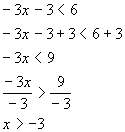
Interval notation: (-3, )
Graph:
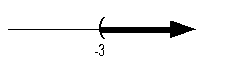
*Inv. of mult. by -3 is div. both sides by -3, so reverse inequality sign
*Open interval indicating all values greater
than -3
*Visual showing all numbers greater than -3
on the number line
Graph:
We use the same type of notation on the endpoint as we did in the interval
notation, a curved end. Since we needed to indicate all values
greater than -3, the part of the number line that was to the right of -3
was darkened.
Example
8: Solve, write your answer in interval notation and graph
the solution set.
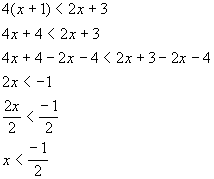
Interval notation: (-,
-1/2)
Graph:
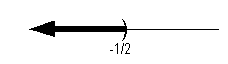
*Inv. of mult. by 2 is div. by 2
*Open interval indicating all values less than
-1/2
*Visual showing all numbers less than -1/2
on the number line.
Interval notation:
Again, we have an open interval since we are not including where it
is equal to -1/2. This time x is less than -1/2, so -1/2 is our largest value of the interval so
it goes on the right. Since there is no lower endpoint (it is ALL
values less than -1/2), we put the negative infinity symbol on the left
side. The curved end on -1/2 indicates an open interval. Negative
infinity always has a curved end because there is not an endpoint on that
side.
Graph:
Again, we use the same type of notation on the endpoint as we did in
the interval notation, a curved end. Since we needed to indicate
all values less than -1/2, the part of the number line that was to the
left of -1/2 was darkened.
Example
9: Solve, write your answer in interval notation and graph
the solution set. 
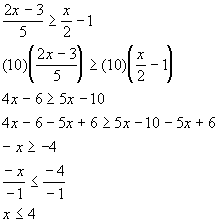
Interval notation: (-,
4]
Graph:
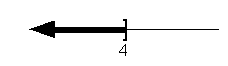
*Mult. both sides by LCD
*Get x terms on one side, constants on the other side
*Inv. of mult. by -1 is div. by -1, so reverse
inequality sign
*Closed interval indicating all values less
than or equal to 4
*Visual showing all numbers less than or equal
to 4 on the number line.
Interval notation:
This time we have a closed interval since we are including where it
is equal to 4. x is less than or
equal to 4, so 4 is our largest value of the interval so it goes
on the right. Since there is no lower endpoint (it is ALL values
less than or equal to 4), we put the negative infinity symbol on the left
side. The boxed end on 4 indicates a closed interval. Negative
infinity always has a curved end because there is not an endpoint on that
side.
Graph:
Again, we use the same type of notation on the endpoint as we did in
the interval notation, a boxed end this time. Since we needed
to indicate all values less than or equal to 4, the part of the number
line that was to the left of 4 was darkened.
Practice Problems
To get the most out of these, you should work the problem out on your own and then check your answer by clicking on the link for the answer/discussion for that problem. At the link you will find the answer as well as any steps that went into finding that answer.
Practice Problems 1a - 1c: Solve, write your answer in interval notation and graph the solution set.
Need Extra Help on these Topics?
http://www.sosmath.com/algebra/inequalities/ineq01/ineq01.html
This website helps you with linear inequalities.
http://www.math.com/school/subject2/lessons/S2U3L4DP.html
This website helps you with linear inequalities.
Go to Get Help Outside the Classroom found in Tutorial 1: How to Succeed in a Math Class for some more suggestions.

Last revised on July 3, 2011 by Kim Seward.
All contents copyright (C) 2001 - 2011, WTAMU and Kim Seward. All rights reserved.


