VML banner
wt linkvml linkcollege algebra linkintermediate algebrabeginning algebra linkgre linkthea link

College Algebra
Answer/Discussion to Practice Problems  
Tutorial 9: Multiplying and Dividing Rational Expressions


WTAMU > Virtual Math Lab > College Algebra > Tutorial 9: Multiplying and Dividing Rational Expressions


Answer/Discussion to 1a


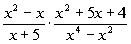
Step 1: Factor both the numerator and the denominator

AND


Step 2: Write as one fraction.

 
*Factor the num. and den.


In the numerator we factored a  GCF and a trinomial.

In the denominator we factored a GCF and a difference of squares.


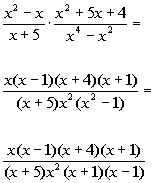
Step 3: Simplify the rational expression.

AND


Step 4: Multiply any remaining factors in the numerator and/or denominator.


*Simplify by div. out the common factors of 
x, (x - 1) and (x + 1)


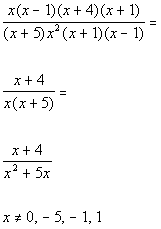
*Multiply the den. out


*Excluded values of the original den.


Note that the values that would be excluded from the domain are 0, -5, -1, and 1.  Those are the values that makes the original denominator equal to 0.

 
(return to problem 1a)


Answer/Discussion to 1b


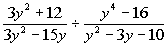
Step 1: Write as multiplication of the reciprocal

AND 

Step 2: Multiply the rational expressions as shown above.
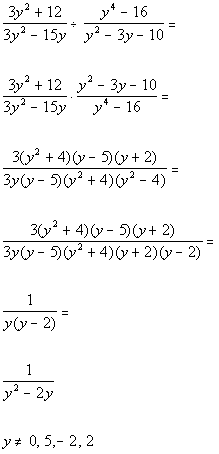


*Rewrite as mult. of reciprocal


*Factor the num. and den.


*Simplify by div. out the common factors of 
3, (y^2 + 4), (y - 5), and (y + 2)
 

*Multiply the den. out


*Excluded values of the original den. of product


In the numerator of the product we factored a GCF and a trinomial.

In the denominator we factored a GCF  and a difference of squares.


Note that even though all of the factors in the numerator were divided out there is still a 1 in there.  It is easy to think there there is "nothing" left and make the numerator disappear.  But when you divide a factor by itself there is actually a 1 there.  Just like 2/2 = 1 or 5/5 = 1.

Note that the values that would be excluded from the domain are 0, 5, -2, and 2.  Those are the values that makes the original denominator of the product equal to 0.


(return to problem 1b)


WTAMU > Virtual Math Lab > College Algebra > Tutorial 9: Multiplying and Dividing Rational Expressions


All contents copyright (C) 2002 - 2008, WTAMU and Kim Seward. All rights reserved.
Last revised on Feb. 29, 2008 by Kim Seward.