
 Answer/Discussion
to 1a
Answer/Discussion
to 1a

What do you think it is?
Let's find out if you are right:

Since 9 squared is 81, 9 is the square root of 81.
Note that we are only interested in the principal root and since 81
is positive and there is not a sign in front of the radical, our answer
is positive 9. If there had been a negative in front of the radical
our answer would have been -9.
Answer/Discussion
to 1b

What do you think it is?
Let's find out if you are right:

Since -3 cubed is -27, -3 is the cube root of -27.
Answer/Discussion
to 1c

 rule.
rule.

Since the root number and the exponent inside are equal and are the even number 2, we need to put an absolute value around x for our answer.
The reason for the absolute value is that we do not know if x is positive or negative. So if we put x as
our answer and it was negative, it would not be a true statement.
Answer/Discussion
to 1d

What do you think it is?
Let's find out if you are right:
Since there is no such real number that when we square it we get -4,
then the answer is not a real number.
Answer/Discussion
to 2a

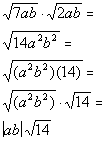
Since we cannot take the square root of 14 and 14 does not have any
factors we can take the square root of, this is as simplified as it gets.
Answer/Discussion
to 2b

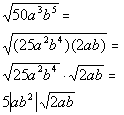
 .
When you simplify a radical, you want to take out as much as possible.
The factor of that we can take the square root of is
.
When you simplify a radical, you want to take out as much as possible.
The factor of that we can take the square root of is  . We can write as
  and then use the product rule of radicals to separate the two numbers.
We can take the square root of ,
which is
and then use the product rule of radicals to separate the two numbers.
We can take the square root of ,
which is  , but
we will have to leave the rest of it under the square root.Answer/Discussion
to 3a
, but
we will have to leave the rest of it under the square root.Answer/Discussion
to 3a

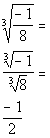
*The cube root of -1 is -1 and the cube root
of 8 is 2
Answer/Discussion
to 3b

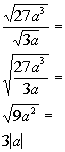
*Simplify the fraction
*The square root of 9 a squared is 3|a|
Answer/Discussion
to 4a

 Answer/Discussion
to 4b
Answer/Discussion
to 4b

Can you think of what that factor is?
Let's see what we get when we simplify the first radical:
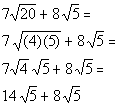
*Square root of 4 is 2
 Answer/Discussion
to 5a
Answer/Discussion
to 5a

Square roots are nice to work with in this type of problem because if the radicand is not a perfect square to begin with, we just have to multiply it by itself and then we have a perfect square.
So in this case we can accomplish this by multiplying top and bottom
by the square root of 7:
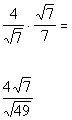
*Den. now has a perfect square under sq. root
AND
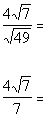
Answer/Discussion
to 5b

So what would the conjugate of our denominator be?
It looks like the conjugate is  .
.
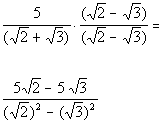
*Use distributive prop. to multiply the numerators
*In general, product of conjugates is 
AND
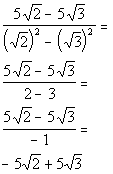
*Square root of 2 squared is 2 and the square
root of 3 squared is 3
*Divide BOTH terms of num. by -1

Last revised on Dec. 6, 2009 by Kim Seward.
All contents copyright (C) 2002 - 2010, WTAMU and Kim Seward. All rights reserved.