WTAMU > Virtual Math Lab > College Algebra > Tutorial 20: Equations that are Quadratic in Form
Answer/Discussion
to 1a

|
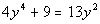
Step 1: Write
in Standard Form, ,
if needed. |
 |
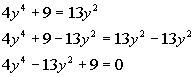
*Inverse of add. 13 y
squared is sub. 13 y squared
*Equation in standard form |
| Below, I have the original equation rewritten in a way to show you
that it is quadratic in form. Note how when you square y
squared you get y to the fourth, which is what
you have in the first term. |
 |
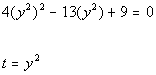
*Rewriting original equation to show it is
quadratic in form
*Note that (y
squared) squared = y to the fourth
*When in stand. form, let t
= the expression following b. |
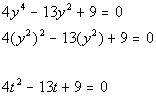
| Next, we need to substitute t in for
y
squared in the original equation. |
 |
*Original equation
*Substitute t in
for y squared |
| Note how we ended up with a quadratic equation when we did our substitution.
From here, we need to solve the quadratic equation that we have created. |
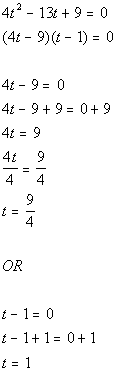
| You can use any method you want to solve the quadratic equation: factoring,
completing the square or quadratic formula.
I'm going to factor it to solve it. |
 |
*Factor
the trinomial
*Use Zero-Product Principle
*Set 1st factor = 0 and solve
*Set 2nd factor = 0 and solve
|
| In step 2 we used the substitution of t
= y squared. |
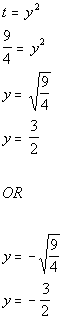
| Let's find the value(s) of y
when t = 9/4: |
 |
*Plug in 9/4 for t
*Use square
root method to solve for y
*First solution
*Second solution
|
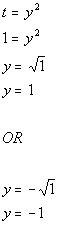
| Let's find the value(s) of y
when t = 1: |
| Step 5: Check
your solutions. |
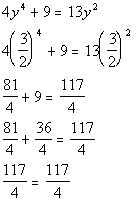
| Let's double check to see if y = 3/2
is a solution to the original equation. |
 |
*Plugging in 3/2 for
y
*True statement
|
| Since we got a true statement, y = 3/2
is a solution. |
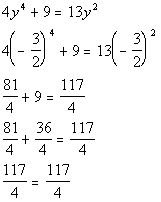
| Let's double check to see if y = -3/2
is a solution to the original equation. |
 |
*Plugging in -3/2 for
y
*True statement
|
| Since we got a true statement, y = -3/2
is a solution. |
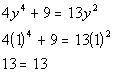
| Let's double check to see if y = 1 is
a solution to the original equation. |
 |
*Plugging in 1 for
y
*True statement |
| Since we got a true statement, y = 1
is a solution. |
| Let's double check to see if y = -1
is a solution to the original equation. |
 |
*Plugging in -1 for
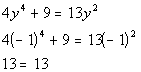
y
*True statement |
| Since we got a true statement, y = -1
is a solution. |
| There are four solutions to this equation: y
= 3/2, y = -3/2,
y
= 1, and y = -1. |
Answer/Discussion
to 1b

|
Step 1: Write
in Standard Form, ,
if needed. |
| This equation is already in standard form. |
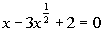
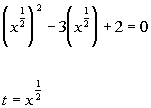
| Below, I have the original equation rewritten in a way to show you
that it is quadratic in form. Note how when you square x
to the 1/2 power you get x, which is what you
have in the first term. |
 |
*Rewriting original equation to show it is
quadratic in form
*Note that (x
to the 1/2 power) squared = x
*When in stand. form, let t
= the expression following b. |
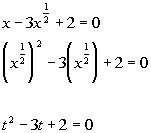
| Next, we need to substitute t in for
x
to
the 1/2 power in the original equation. |
 |
*Original equation
*Substitute t in
for x to the 1/2 power |
| Note how we ended up with a quadratic equation when we did our substitution.
From here, we need to solve the quadratic equation that we have created. |
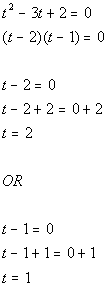
| You can use any method you want to solve the quadratic equation: factoring,
completing the square or quadratic formula.
I'm going to factor it to solve it. |
 |
*Factor
the trinomial
*Use Zero-Product Principle
*Set 1st factor = 0 and solve
*Set 2nd factor = 0 and solve
|
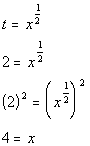
| In step 2 we used the substitution of t
= x to the 1/2 power. |
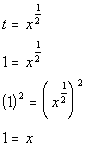
| Let's find the value(s) of x
when t = 2: |
| Let's find the value(s) of x
when t = 1: |
| Step 5: Check
your solutions. |
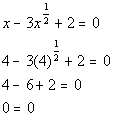
| Let's double check to see if x = 4 is
a solution to the original equation. |
 |
*Plugging in 4 for x
*True statement |
| Since we got a true statement, x = 4
is a solution. |
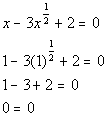
| Let's double check to see if x = 1 is
a solution to the original equation. |
 |
*Plugging in 1 for x
*True statement |
| Since we got a true statement, x = 1
is a solution. |
| There are two solutions to this equation: x
= 4 and x = 1. |
Answer/Discussion
to 1c

|
Step 1: Write
in Standard Form, ,
if needed. |
| This equation is already in standard form. |
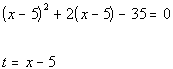
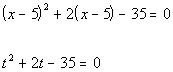
| Note how the original equation has the exact same expression in the
two ( )'s and that the first ( ) is squared and the 2nd (
) is to the one power. This equation is quadratic in form. |
 |
*When in stand. form, let t
= the expression following b. |
| Next, we need to substitute t in for
x
minus 5 in the original equation. |
 |
*Original equation
*Substitute t in
for x minus 5 |
| Note how we ended up with a quadratic equation when we did our substitution.
From here, we need to solve the quadratic equation that we have created. |
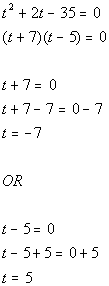
| You can use any method you want to solve the quadratic equation: factoring,
completing the square or quadratic formula.
I'm going to factor it to solve it. |
 |
*Factor
the trinomial
*Use Zero-Product Principle
*Set 1st factor = 0 and solve
*Set 2nd factor = 0 and solve
|
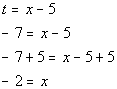
| In step 2 we used the substitution of t
= x - 5. |
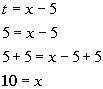
| Let's find the value(s) of x
when t = -7: |
 |
*Plug in -7 for t
*Inverse of sub. 5 is add. 5 |
| Let's find the value(s) of x
when t = 5: |
 |
*Plug in 5 for t
*Inverse of sub. 5 is add. 5 |
| Step 5: Check
your solutions. |
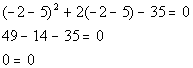
| Let's double check to see if x = -2
is a solution to the original equation. |
 |
*Plugging in -2 for x
*True statement |
| Since we got a true statement, x = -2
is a solution. |
| Let's double check to see if x = 10
is a solution to the original equation. |
 |
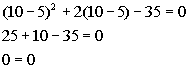
*Plugging in 10 for
x
*True statement |
| Since we got a true statement, x = 10
is a solution. |
| There are two solutions to this equation: x
= -2 and x = 10. |

WTAMU > Virtual Math Lab > College Algebra > Tutorial 20: Equations that are Quadratic in Form
All contents copyright (C) 2002 - 2008, WTAMU and Kim Seward.
All rights reserved.
Last revised on July 14, 2008 by Kim Seward.
|