VML banner
wt linkvml linkcollege algebra linkintermediate algebrabeginning algebra linkgre linkthea link

College Algebra
Answer/Discussion to Practice Problems  
Tutorial 14: Linear Equations in One Variable


WTAMU > Virtual Math Lab > College Algebra > Tutorial 14: Linear Equations in One Variable


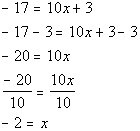
Answer/Discussion to 1a


*Inverse of add. 3 is sub 3 from both sides
 

*Inverse of mult. by 10 is div. both sides by 10


If you put -2 back in for x in the original problem you will see that -2 is the solution we are looking for.

 
(return to problem 1a)


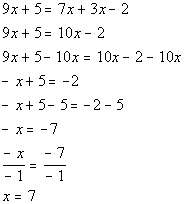
Answer/Discussion to 1b


*Get all x terms on one side

*Inverse of add. 5 is sub. 5
 

*Inverse of mult. by -1 is div. by -1


If you put 7 back in for x in the original problem you will see that 7 is the solution we are looking for.

 
(return to problem 1b)


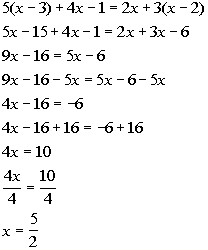
Answer/Discussion to 1c


*Remove ( ) by using dist. prop.
*Combine like terms

*Get all x terms on one side

*Inverse of sub. 16 is add. 16


*Inverse of mult. by 4 is div. by 4


If you put 5/2 back in for x in the original problem you will see that 5/2 is the solution we are looking for.

 
(return to problem 1c)


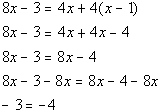
Answer/Discussion to 2a


*Remove ( ) by using dist. prop.
*Combine like terms

*Get all the x terms on one side


Where did our variable, x, go???  It disappeared on us.  Also note how we ended up with a FALSE statement, -3 is not equal to -4.  This does not mean that x = -3 or x = -4. 

Whenever your variable drops out AND you end up with a FALSE statement, then after all of your hard work, there is NO SOLUTION.

So, the answer is no solution which means this is an inconsistent equation.


(return to problem 2a)


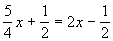
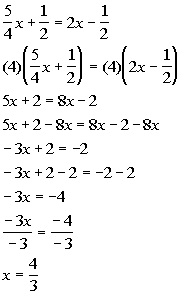
Answer/Discussion to 2b


*To get rid of the fractions, 
mult. both sides by the LCD of 4


*Get all the x terms on one side
 

*Inverse of add. 2 is sub. 2


*Inverse of mult. by -3 is div. by -3


If you put 4/3 back in for x in the original problem you will see that 4/3  is the solution we are looking for.

This would be an example of a conditional equation, because we came up with one solution.


(return to problem 2b)


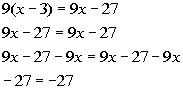
Answer/Discussion to 2c


*Remove ( ) by using dist. prop.

*Get all the x terms on one side


Where did our variable, x, go???  It disappeared on us.  Also note how we ended up with a TRUE statement, -27 does indeed equal -27.  This does not mean that x = -27. 

Whenever your variable drops out AND you end up with a TRUE statement, then the solution is ALL REAL NUMBERS. This means that if you plug in any real number for x in this equation, the left side will equal the right side.

So the answer is all real numbers, which means this equation is an identity.


(return to problem 2c)


WTAMU > Virtual Math Lab > College Algebra > Tutorial 14: Linear Equations in One Variable


All contents copyright (C) 2002 - 2008, WTAMU and Kim Seward. All rights reserved.
Last revised on May 16, 2008 by Kim Seward.