
 Learning Objectives
Introduction
In this tutorial we will be looking at basic concepts of central tendencies. We will go over how to find the mean, median and mode of a list of values as well as the range and standard deviation. I think you are ready to get started on these central tendencies.
Tutorial
You can find the mean by adding up all the values and then dividing that sum by the number of values that you have.
There is only one mean to a list of values.
The mean may or may not be a number that is in the original list of values.
This does not necessarily mean it is the middle number in the original list. You need to make sure that your values are in numeric order from smallest to largest before you find the median.
There is only one median to a list of values.
The median may or may not be a number that is in the original list of values.
You can have more than one mode, if more than one value occurs the same amount of times and that is the highest occurrence.
 Example
1: A student received the following grades on
quizzes
in a history course: 80, 88, 75, 93, 79, 95, 75, and 96.
Example
1: A student received the following grades on
quizzes
in a history course: 80, 88, 75, 93, 79, 95, 75, and 96. Find the mean, median and mode of the quizzes.
So we need to sum up all of the quizzes and then divide by 8, since there are 8 quizzes:
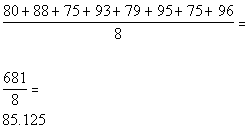
*Add numerator
*Divide by 8
We need to list the numbers in numeric order:
75, 75, 79, 80, 88, 93, 95, 96
If we pick 80 for our median we have 3 values below it and 4 above it. If we pick 88 for our median then we have 4 values below it and 3 above it. So neither of those values are the median. This does not mean we don’t have a median.
Note how there is an even number of values listed. If that is the case, we need to draw a line down the middle of the list and take the mean of the two numbers next to that line:
75, 75, 79, 80 | 88, 93, 95, 96
The mean of 80 and 88 is
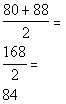
It helps to list the numbers in order to find the mode.
75, 75,
79, 80, 88, 93, 95, 96
Note how 75 occurs two times, which is the value that occurs the most.
75 is the mode.
Example
2: The number of points a kicker made during the
first five games of the season are given in the table: Find the mean, median and mode of the points.
So we need to sum up all of the points and then divide by 5, since there are 5 games:
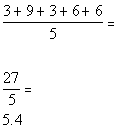
*Add numerator
*Divide by 5
We need to list the numbers in numeric order:
3, 3, 6, 6, 9
This time we have an odd number of values. Our median is going to be 6 (the first 6 listed). That number has two values above it and two below it, so it is the middle value.
6 is the median. It is the value that is right smack dab in the middle of this list of values.
It helps to list the numbers in order to find the mode.
3, 3, 6, 6,
9
Note how both 3 and 6 occur two times, which is the most.
Both 3 and 6 are the mode.
Example
3: If your scores of the first four exams are
98,
100, 90 and 97, what do you need to make on the next exam for your
overall
mean to be at least 90?Keep in mind that this is still a mean problem. We will still use the idea that we need to sum up the exams and then divide it by 5 to get the mean. We can let our unknown exam be x.
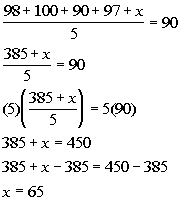
*Solve for x (missing test)
*Inverse of div. by 5 is mult.
by 5
*Inverse of add 385 is sub. 385
Example
4: A student has received scores of 88, 82, and 84 on
3 quizzes. If the tests count twice as much as the quizzes, what
is the lowest score the student can get on the next test to achieve an
average score of at least 80?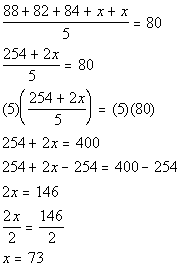
*Inverse of div. by 5 is mult.
by 5
*Inverse of add 254 is sub. 254
Note that the range only involves two values in its calculation - the highest and the lowest. However, the standard deviation involves every value of its data set.
Step 1: Find the mean of the values of the data set.
Step 2: Find the difference between the mean and each separate value of the data set.
Step 3: Square each difference found in step 2.
Step 4: Add up all of the squared values found in step 3.
Step 5: Divide the sum found in step 4 by the number of data values in the set.
Step 6: Find the nonnegative square root of the quotient found in step 5.
Example
5: Find the range and the standard deviation of the
following
sample: 3, 10, 8, 20, 4, 4, 3, 8, 8, 8, 12.Let's find the range. What do you think it is?
Looking at the difference between the largest value, which is 20 and the smallest value, which is 3, it looks like the range is 17.
Now lets tackle the standard deviation.
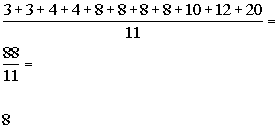
*Add numerator
*Divide by 11
 3
-5
25
3
-5
25
4
-4
16
4
-4
16
8
0
0
8
0
0
8
0
0
8
0
0
10
2
4
12
4
16
20
12
144
SUM:
246
3
-5
25
3
-5
25
4
-4
16
4
-4
16
8
0
0
8
0
0
8
0
0
8
0
0
10
2
4
12
4
16
20
12
144
SUM:
246

For example, if you had the list of test scores for a
class:
75, 80, 90, 80, 75, 75, 50, 65, 65, 50, 100, 90, 100, 90, 75, 40, 60,
60
Writing these values (x) in a frequency (f) distribution chart you would have:
Example
6: Find the mean of the test scores 75, 80, 90, 80,
75,
75, 50, 65, 65, 50, 100, 90, 100, 90, 75, 40, 60, 60, using a frequency
distribution.As shown above, the frequency distribution for this set of numbers is
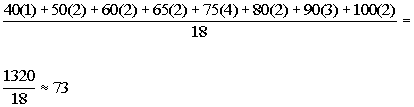
*calculate numerator
*divide
Practice Problems
To get the most out of these, you should work the problem out on your own and then check your answer by clicking on the link for the answer/discussion for that problem. At the link you will find the answer as well as any steps that went into finding that answer.
Practice Problem 1a: Find the mean, median, and mode.
1a. The number of cd’s sold by Dave’s Discs for the last 6 days are given in the table.
Day Day 1 Day 2 Day 3 Day 4 Day 5 Day 6 CD's 15 10 10 10 18 15Find the mean, median, and mode.
(answer/discussion
to 1a)
2a. A student received scores of 92, 83, and 71
on three quizzes.
If tests count twice as much as quizzes, what is the lowest score that
the student can get on the next test to achieve a mean of at least 80?
(answer/discussion
to 2a)
Need Extra Help on these Topics?
Go to Get Help Outside the Classroom found in Tutorial 1: How to Succeed in a Math Class for some more suggestions.

Last revised on August 7, 2011 by Kim Seward.
All contents copyright (C) 2001 - 2011, WTAMU and Kim Seward. All rights reserved.