
 Learning Objectives
Introduction
Tutorial
Linear Inequalities in Two Variables
A linear inequality in two variables
is any expression
that can be put in the form

where a, b, and c are constants
The solution set and graph for a linear inequality is a region of the rectangular coordinate system. Recall that the graph of a linear equation is a straight line. The inequality sign extends this to being on one side of the line or the other on the graph.
When you draw the boundary line, you need to have a way to indicate if the line is included or not in the final answer.
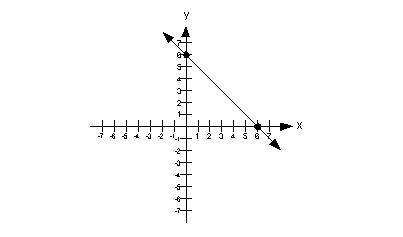
Solid boundary
line: < or >
If the problem includes where it is equal, then you will have a solid
boundary line. In other words, if you have < or > , you will have a solid line for your boundary line.
This shows the boundary line for x +
y < 6:
(note that this does not show the inequality part)
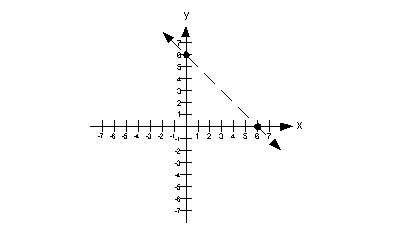
Dashed boundary
line: < or
>
If the problem does not include where it is equal, then you will use
a dashed boundary line. In other words, if you have < or >,
you
will have a dashed line for your boundary line.
This shows the boundary line for x +
y < 6:
(note that this does not show the inequality part)
In either case, you still graph the line the same. You just have to decide if you are needing a solid line or a dashed line.
The boundary line separates the rectangular coordinate system into two parts. One of those parts will make the inequality true and be it’s solution.
If you get a false statement when you plug in the test point in step 2, then you don’t have a solution. Shade in the region that is on the other side of the test point.
It doesn’t matter what you use for the test point as
long as it is not
on the
boundary line. You want to keep it as simple as possible.
 Example
1: Graph the inequality
Example
1: Graph the inequality  .
.When I’m working with only the boundary line, I will put an equal sign between the two sides to emphasize that we are working on the boundary line. That doesn’t mean that I changed the problem. When we put it all together in the end, I will put the inequality back in.
What value is y on
the x-intercept?
If you said 0, you are correct.
If you need a review on x-intercepts,
go to Tutorial 22: Intercepts.

What is the value of x on the y-intercept?
If you said 0, you are correct.
If you need a review on y-intercepts,
go to Tutorial 22: Intercepts.

Plug in 1 for x to get a third solution:
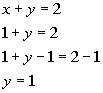
Solutions:
Since the original problem has a >, this means it DOES NOT include the boundary line.
So are we going to draw a solid or a dashed line for
this problem?
It looks like it will have to be a dashed line.
Putting it all together, we get the following boundary line for this problem:
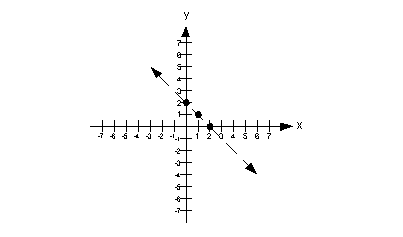
An easy test point would be (0, 0). Note that it is a point that is not on the boundary line. In fact, it is located below the boundary line.
Let’s put (0, 0) into the original problem and see what happens:

Since it has to be on one side or the other of the boundary line, and it is not below it, then our solution would lie above the boundary line. This means we will shade in the part that is above it.
Note that the gray lines indicate where you would shade your final answer.
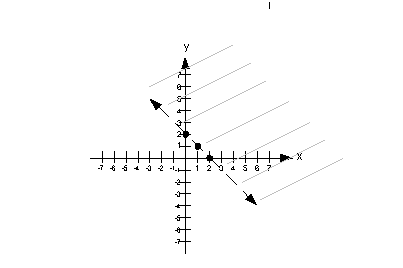 Example
2: Graph the inequality
Example
2: Graph the inequality  .
.When I’m working with only the boundary line, I will put an equal sign between the two sides to emphasize that we are working on the boundary line. That doesn’t mean that I changed the problem. When we put it all together in the end, I will put the inequality back in.
What value is y on
the x-intercept?
If you said 0, you are correct.
If you need a review on x-intercepts,
go to Tutorial 22: Intercepts.
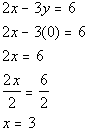
*Inverse of mult. by 2 is div. by 2
*x-intercept
What is the value of x on the y-intercept?
If you said 0, you are correct.
If you need a review on y-intercepts, go to Tutorial 22: Intercepts.
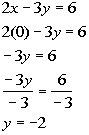
*Inverse of mult. by -3 is div.
by -3
*y-intercept
Plug in 1 for x to get a third solution:
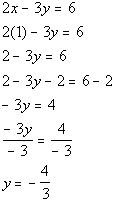
*Inverse of add 2 is sub. 2
*Inverse of mult. by -3 is div.
by -3
Solutions:
Since the original problem has a <, this means it DOES include the boundary line.
So are we going to draw a solid or a dashed line for
this problem?
It looks like it will have to be a solid line.
Putting it all together, we get the following boundary line for this problem:
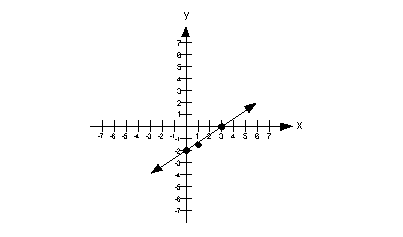
An easy test point would be (0, 0). Note that it is a point that is not on the boundary line. In fact, it is located above the boundary line.
Let’s put (0, 0) into the original problem and see what happens:

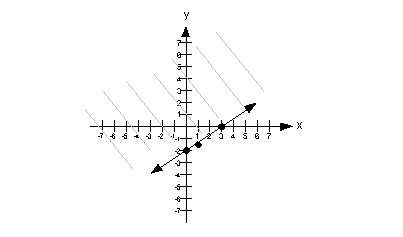
Our solution would lie above the boundary line. This means we will shade in the part that is above it.
Note that the gray lines indicate where you would shade your final answer.
 Example
3: Graph the inequality
Example
3: Graph the inequality  .
.Do you remember what type of line x = c graphs as?
It comes out to be a vertical line.
If you need a
review on
vertical lines, go to Tutorial 22: Intercepts
Every x’s value on the boundary line would have to be 4.
Solutions:
So are we going to draw a solid or a dashed line for
this problem?
It looks like it will have to be a dashed line.
Putting it all together, we get the following boundary line for this problem:
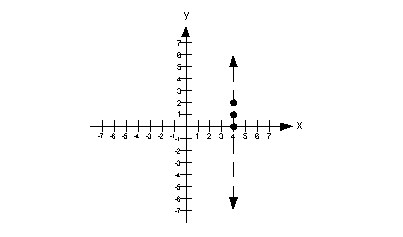
An easy test point would be (0, 0). Note that it is a point that is not on the boundary line. In fact, it is located to the left of the boundary line.
Let’s put (0, 0) into the original problem and see what happens:

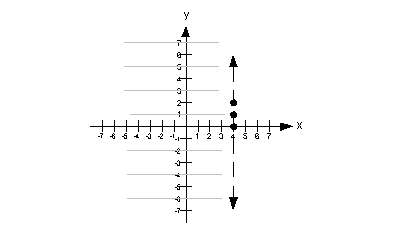
Our solution would lie to the left of the boundary line. This means we will shade in the part that is to the left of it
Note that the gray lines indicate where you would shade your final answer.
Practice Problems
To get the most out of these, you should work the problem out on your own and then check your answer by clicking on the link for the answer/discussion for that problem. At the link you will find the answer as well as any steps that went into finding that answer.
Practice Problems 1a - 1b: Graph each inequality.
Need Extra Help on these Topics?
The following is a webpage
that can assist
you in the topics that were covered on this page:
http://www.purplemath.com/modules/ineqgrph.htm
This website helps you with graphing linear inequalities.
Go to Get Help Outside the Classroom found in Tutorial 1: How to Succeed in a Math Class for some more suggestions.

Last revised on July 31, 2011 by Kim Seward.
All contents copyright (C) 2001 - 2011, WTAMU and Kim Seward. All rights reserved.

