(Back to the tutorial on the multiplication property of equality)

Beginning Algebra
Answer/Discussion to Practice Problems
on Multiplication Property of Equality


Answer/Discussion to 1a


*Inverse of mult. by -8 is div. by -8 

 
If you put -3 back in for a in the original problem you will see that -3 is the solution we are looking for.

 
(return to problem 1a)


Answer/Discussion to 1b


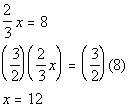
*Inverse of mult. by 2/3 is did. by 2/3 
(or mult. by reciprocal 3/2)

 
If you put 12 back in for x in the original problem you will see that 12 is the solution we are looking for.

 
(return to problem 1b)


Answer/Discussion to 1c


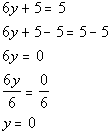
*Inverse of add 5 is sub. 5

*Inverse of mult. by 6 is div. by 6


If you put 0 back in for y in the original problem you will see that 0 is the solution we are looking for.

 
(return to problem 1c)


Answer/Discussion to 1d


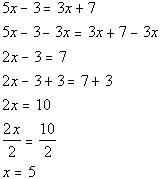
*Inverse of add 3x is sub. 3x
 

*Inverse of sub.  3 is add 3
 

*Inverse of mult. by 2 is div. by 2


If you put 5 back in for x in the original problem you will see that 5 is the solution we are looking for.

 
(return to problem 1d)


Answer/Discussion to 2a

If x represents the first of three consecutive integers, express the sum of the three integers in terms of x.


First of all, we need to have all three consecutive integers in terms of x

We can represent them the following way:
 

x         = 1st integer

x + 1   = 2nd consecutive integer

x + 2   = 3rd consecutive integer

Second we need to write it as a sum of the three integers and then simplify it:
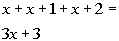

 
*The sum of the three cons. integers
*Combine like terms

 
(return to problem 2a)


(Back to the tutorial on the multiplication property of equality)


All contents copyright (C) 2001 - 2008, WTAMU and Kim Seward. All rights reserved.
Last revised on Jan. 9, 2002 by Kim Seward.