Intermediate Algebra
Answer/Discussion to Practice Problems
Tutorial 22: Practice Test on Tutorials 19 - 21
1a.
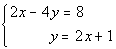
 Answer: Answer:
|
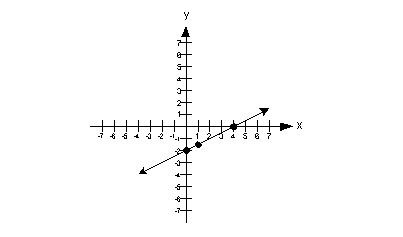
Step 1: Graph the first equation. |
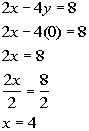
The x-intercept is (4, 0).
y-intercept |
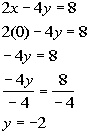
The y-intercept is (0, -2).
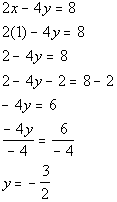
Find another solution by letting x = 1 |
Another solution is (1, -3/2).
Solutions:
|
x
|
y
|
(x, y)
|
|
4
|
0
|
(4, 0)
|
|
0
|
-2
|
(0, -2)
|
|
1
|
-3/2
|
(1, -3/2)
|
Plotting the ordered pair solutions and drawing the line:
 |
Step 2: Graph the second equation on the same coordinate
system as the first. |
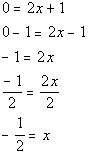
The x-intercept is (-1/2, 0).
y-intercept |
The y-intercept is (0, 1).
Find another solution by letting x = 1. |
Another solution is (1, 3).
Solutions:
|
x
|
y
|
(x, y)
|
|
-1/2
|
0
|
(-1/2, 0)
|
|
0
|
1
|
(0, 1)
|
|
1
|
3
|
(1, 3)
|
Plotting the ordered pair solutions and drawing the line:
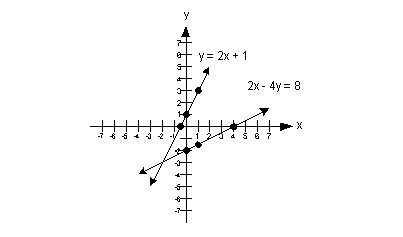 |
Step 3: Find the solution. |
We need to ask ourselves, is there any place that the two lines intersect,
and if so, where?
The answer is yes, they intersect at (-2, -3). |
Step 4: Check the proposed ordered pair solution in
BOTH equations. |
You will find that if you plug the ordered pair (-2, -3) into BOTH
equations of the original system, this is a solution to BOTH of them.
The solution to this system is (-2, -3). |
2a.
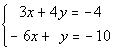
Answer: |
Step 1: Simplify if needed. |
Both of these equations are already simplified. No work needs
to be done here. |
Step 2: Solve one equation for either variable. |
It does not matter which equation or which variable you choose to solve
for. But it is to your advantage to keep it as simple as possible.
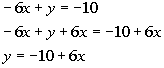
Second equation solved for y: |
Step 3: Substitute what you get for step 2 into the
other equation
AND
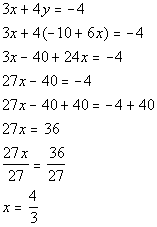
Step 4: Solve for the remaining variable . |
Substitute the expression -10 + 6x for y into the first equation and solve
for x:
(when you plug in an expression like this, it is just like you plug
in a number for your variable) |
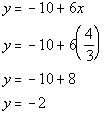
Step 5: Solve for second variable. |
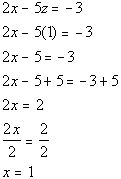
Plug in 4/3 for x into the equation
in step 2 to find y's value. |
Step 6: Check the proposed ordered pair solution in
BOTH original equations. |
You will find that if you plug the ordered pair (4/3, -2) into BOTH
equations of the original system, that this is a solution to BOTH of them.
(4/3, -2) is a solution to our system. |
3a.
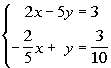
Answer: |
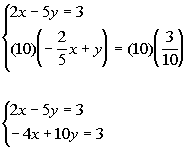
Step 1: Simplify and put both equations in the form
Ax + By = C if needed. |
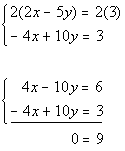
Multiplying each equation by it's respective LCD we get: |
Step 2: Multiply one or both equations by a number
that will create opposite coefficients for either x or y if needed
AND
Step 3: Add equations |
I propose that we multiply the first equation by 2, this would create
a 4 in front of x and we will have our opposites.
Multiplying the first equation by 2 we get: |
Step 4: Solve for remaining variable. |
Since both variables dropped out AND we have a FALSE statement, then
our answer is no solution. |
Step 5: Solve for second variable. |
No variable to plug in here. |
Step 6: Check the proposed ordered pair solution in
BOTH original equations. |
The answer is no solution. |
4a.
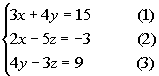
Answer: |
Note that the numbers in ( ) are equation
numbers. They will be used throughout the problems for reference
purposes. |
Step 1: Simplify and put both equations in the form
Ax + By + Cz = D if needed. |
No simplification needed here. Let's go on to the next step. |
Step 2: Choose to eliminate any one of the variables
from any pair of equations. |
I choose to eliminate y.
Since z is already eliminated from the
first equation we will use that first equation in it's original form for
this step: |
Step 3: Eliminate the SAME variable chosen in
step 2 from any other pair of equations creating a system of two equations
and 2 unknowns. |
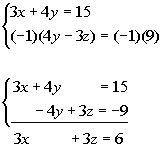
We are still going after eliminating z,
this time I want to use the second and the third equations.
Multiplying the third equation by -1 and adding this to the first
equation we get: |
Step 4: Solve the remaining system found in
step 2 and 3. |
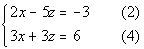
Let's first put those equations together: |
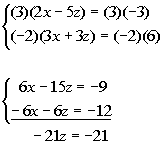
I'm going to choose x to eliminate.
Multiplying equation (2) by 3 and equation (4) by -2 and then adding
them together we get: |
If we go back one step to the system that had two equations and
two variables and plug in 1 for z in equation (2), we would get: |
Step 5: Solve for the third variable. |
Now we need to go back to the original system and pick any equation
to plug in the two known variables and solve for our last variable .
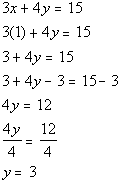
I choose equation (1) to plug in 1 for x that we found: |
You will find that if you plug the ordered triple (1, 3, 1) into ALL
THREE equations of the original system, this is a solution to ALL THREE
of them.
(1, 3, 1) is a solution to our system. |
5a.
A boat on a river travels 20 miles downstream in only 2 hours.
It takes the same boat 6 hours to travel 12 miles upstream. What
are the speed of the boat and the speed of the current? Answer: |
Step 1: Understand the problem. |
Make sure that you read the question carefully several times.
Since we are looking for two different rates, we will let
x = rate of the boat
y = the rate of the current
Keep in mind that the current is affecting the overall speed.
When the boat is going downstream, it will be going faster.
That rate will be x + y.
When the boat is going upstream, it will be going slower. That
rate will be x - y.
|
|
(Rate)
|
(Time)
|
= Distance
|
|
Downstream
|
x + y
|
2
|
20
|
|
Upstream
|
x - y
|
6
|
12
|
|
Step 2: Devise a plan (translate). |
Since we have two unknowns, we need to build
a system with two equations.
Equation (1):
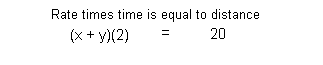
Equation (2):
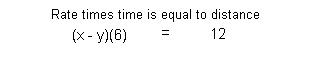 |
Putting the two equations together in a system we get:
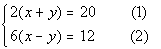
|
Step 3: Carry out the plan (solve). |
Simplify if needed.
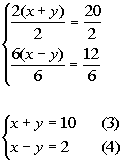
We can simplify this by dividing both sides of equation (1) by 2
and equation (2) by 6 getting rid of the ( ): |
Multiply one or both equations by a number
that will create opposite coefficients for either x or y if needed AND
add the equations.
Since we already have opposite coefficients
on y, we can go right into adding equations (3) and (4) together: |
Solve for remaining variable.
Solving for x we get: |
Solve for second variable.
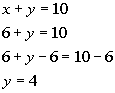
Using equation (3) to plug in 6 for x and solving for y we get: |
Step 4: Look back (check and interpret). |
You will find that if you plug the ordered pair (6, 4) into BOTH equations
of the original system, this is a solution to BOTH of them.
Final Answer:
The boat speed is 6 mph and the current speed is 4 mph. |
5b.
The sum of three numbers is 8. Twice the smallest is 2 less than
the largest, while the sum of the largest and the smallest is 5.
What are the three numbers? Answer: |
Step 1: Understand the problem. |
Make sure that you read the question carefully several times.
Since we are looking for three numbers, we will let
x = the smallest number
y = middle number
z = the largest number |
Step 2: Devise a plan (translate). |
Since we have three unknowns, we need to build
a system with three equations.
Equation (1):

Equation (2):
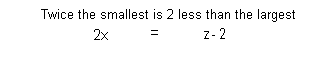
Equation (3):
 |
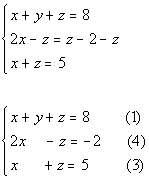
Putting the three equations together in a system we get:
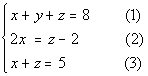
|
Step 3: Carry out the plan (solve). |
Simplify and put all three equations in the
form Ax + By + Cz = D if needed.
Equation (2) needs to be put in the correct form: |
Choose to eliminate any one of the variables
from any pair of equations.
Since y is already eliminated in equation
(4) and (3), it would be quickest and easiest to eliminate y.
We can use equation (4) as one equation with y eliminated: |
Eliminate the SAME variable chosen in step
2 from any other pair of equations creating a system of two equations and
2 unknowns.
We can use equation (3) as another equation with y eliminated: |
Solve the remaining system found in the above
steps
Putting those two equations together we get: |
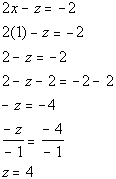
Using equation (4) to plug in 1 for x and solving for z we get: |
Solve for the third variable.
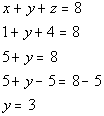
Using equation (1) to plug 1 in for x and 4 for z and solving for y we get: |
Step 4: Look back (check and interpret). |
You will find that if you plug the ordered triple (1, 3, 4) into ALL
THREE equations of the original system, this is a solution to ALL THREE
of them.
Final Answer:
1 is the smallest number, 3 is the middle number and 4 is the largest
number. |

Last revised on July 6, 2011 by Kim Seward.
All contents copyright (C) 2001 - 2011, WTAMU and Kim Seward.
All rights reserved.
|
|