Intermediate Algebra
Tutorial 20: Solving Systems of Linear Equations
in Three Variables
 Learning Objectives
Introduction
In this tutorial we will be specifically looking at systems that have three linear equations and three unknowns. In Tutorial 19: Solving Systems of Linear Equations in Two Variables we covered systems that have two linear equations and two unknowns. We will only look at solving them using the elimination method. Don't get overwhelmed by the length of some of these problems. Just keep in mind that a lot of the steps are just like the ones from the elimination method of two equations and two unknowns that were covered in Tutorial 19: Solving Systems of Linear Equations in Two Variables, just more of them.
Tutorial
In this tutorial, we will be looking at systems that have three linear equations and three unknowns.
Tutorial 19: Solving a System of Linear Equations in Two Variables looked at three ways to solve linear equations in two variables.
In other words, it is what they all three have in common. So if an ordered triple is a solution to one equation, but not another, then it is NOT a solution to the system.
Note that the linear equations in two variables found in Tutorial 19: Solving a System of Linear Equations in Two Variables graphed to be a line on a two dimensional Cartesian coordinate system. If you were to graph (which you won't be asked to do here) a linear equation in three variables you would end up with a figure of a plane in a three dimensional coordinate system. An example of what a plane would look like is a floor or a desk top.
Recall the following from
Tutorial 19:
Solving a System
of Linear Equations in Two Variables:
A consistent system is a system that has at least one solution.
An inconsistent system is a system that has
no solution.
The equations of a system are dependent if ALL the solutions of one equation are also solutions of the other two equations. In other words, they end up being the same line.
The equations of a system are independent if they do not share ALL solutions. They can have one point in common, just not all of them.
If you do get one solution for your final answer, is
this system consistent or inconsistent?
If you said consistent, give yourself a pat on the back!
If you do get one solution for your final answer, would
the equations be dependent or independent?
If you said independent, you are correct!
If you get no solution for your final answer, is
this system consistent or inconsistent?
If you said inconsistent, you are right!
If you get no solution for your final answer, would
the equations be dependent or independent?
If you said independent, you are correct!
If you get an infinite number of solutions for
your final answer, is
this system consistent or inconsistent?
If you said consistent you are right!
If you get an infinite number of solutions for
your final answer, would
the equations be dependent or independent?
If you said dependent you are correct!
If you have another way of doing it, by all means, do it your way, then you can check your final answers with mine. No matter which way you choose to do it, if you are doing it correctly, the answer is going have to be the same.
To remove ( ): just use the distributive property.
To remove fractions: since fractions are another way to write division, and the inverse of divide is to multiply, you remove fractions by multiplying both sides by the LCD of all of your fractions.
At this point, you are only working with two of your equations. In the next step you will incorporate the third equation into the mix.
Looking ahead, you will be adding these two equations together. In that process you need to make sure that one of the variables drops out, leaving one equation and two unknowns. The only way you can guarantee that is if you are adding opposites. The sum of opposites is 0.
It doesn't matter which variable you choose to drop out. You want to keep it as simple as possible. If a variable already has opposite coefficients than go right to adding the two equations together. If they don't, you need to multiply one or both equations by a number that will create opposite coefficients in one of your variables. You can think of it like a LCD. Think about what number the original coefficients both go into and multiply each separate equation accordingly. Make sure that one variable is positive and the other is negative before you add.
For example, if you had a 2x in one equation and a 3x in another equation, you could multiply the first equation by 3 and get 6x and the second equation by -2 to get a -6x. So when you go to add these two together they will drop out.
When you solve this system that has two equations and two variables, you will have the values for two of your variables.
Remember that if both variables drop out and you have a FALSE statement, that means your answer is no solution.
If both variables drop out and you have a TRUE statement, that means your answer is infinite solutions, which would be the equation of the line.
If it makes at least one of them false, you need to go back and redo the problem.
 Example
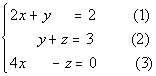
1: Solve the system.
Example
1: Solve the system. 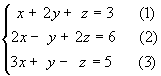
Basically, we are going to do the same thing we did with the systems of two equations, just more of it. In other words, we will have to do the elimination twice, to get down to just one variable since we are starting with three variables this time.
Let’s first eliminate y using the first and second equations. This process is identically to how we approached it with the systems found in Tutorial 19: Solving a System of Linear Equations in Two variables.
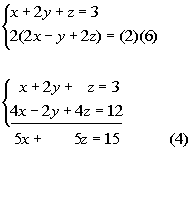
If I multiply 2 times the second equation, then the y terms will be opposites of each other and ultimately drop out.
Multiplying 2 times the second equation and then adding that to the first equation we get:
*y's
have opposite
coefficients
*y's
dropped out
I picked the second and third on this example because the y terms are already opposites so we don't have to multiply by anything, we can go straight to adding them together:
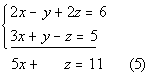
*y's dropped out
Let’s first put those equations together:
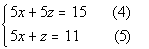
I’m going to go ahead and multiply equation (5) by -1 and then add the equations together:
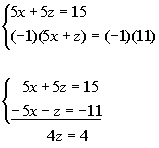
*x's have opposite coefficients
*x's
dropped out

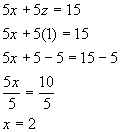
*Inverse of mult. by 5 is div.
by 5
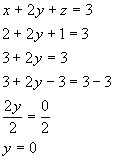
I choose equation (1) to plug in our 2 for x and 1 for z that we found:
*Inverse of add 3 is sub. 3
*Inverse of mult. by 2 is div. by 2
(2, 0, 1) is a solution to our system.
Example
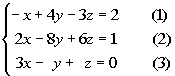
2: Solve the system. 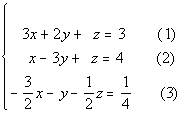
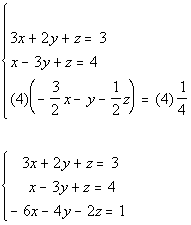
*Mult. eq. (3) by LCD 4
Let’s first eliminate z using the first and second equations. This process is identical to how we approached it with the systems found in Tutorial 19: Solving a System of Linear Equations in Two variables. If we multiply -1 times the second equation, then the z terms will be opposites of each other and ultimately drop out.
Multiplying -1 times the second equation and then adding that to the first equation we get:
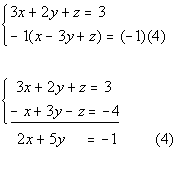
*z's have opposite coefficients
*z's
dropped out
It looks like we will have to multiply the first equation by 2, to get opposites on z.
Multiplying the first equation by 2 and then adding equations (1) and (3) together we get:
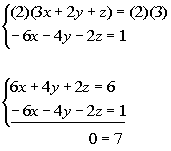
*z's have opposite coefficients
*All three variables drop out
AND
we have a FALSE statement
Final answer is no solution.
Example
3: Solve the system. 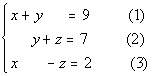
I choose to eliminate z.
Since z is already eliminated from the first equation we will use that first equation in its original form for this step:

Looks like the z’s in the second and third equations already have opposites, so we just need to add them together:
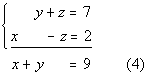
*z's dropped out
You can use either elimination or substitution method to solve it. I’m going to go ahead and stick with the elimination method to complete this.
Let’s first put those equations together:
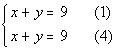
Let’s go ahead and show this step by multiplying equation (4) by -1, to get opposite coefficients for x and then add the two equations together.
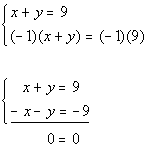
*x's have opposite coefficients
*All variables dropped out AND
we have a TRUE statement
You can write your answer in a variety of ways:
{(x, y, z) | x + y = 9} OR {(x,
y, z) | y + z =
7} OR {(x, y, z) | x - z = 2}
Practice Problems
To get the most out of these, you should work the problem out on your own and then check your answer by clicking on the link for the answer/discussion for that problem. At the link you will find the answer as well as any steps that went into finding that answer.
Practice Problems 1a - 1b: Solve the system.
Need Extra Help on these Topics?

Last revised on July 10, 2011 by Kim Seward.
All contents copyright (C) 2001 - 2011, WTAMU and Kim Seward. All rights reserved.