Intermediate Algebra
Answer/Discussion to Practice
Problems
on Solving Systems of Linear
Equations
in Two Variables
Answer/Discussion
to 1a

|
 |
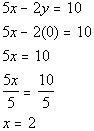
*Plug in 0 for y
for x-int
*Inverse of mult. by 5 is div. by 5
*x-intercept |
The x-intercept is (2, 0).
y-intercept |
 |
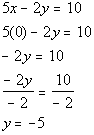
*Plug in 0 for x
for y-int
*Inverse of mult. by -2 is div. by -2
*y-intercept |
The y-intercept is (0, -5).
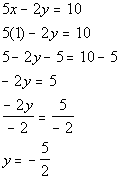
Find another solution by letting
x
= 1. |
 |
*Plug in 1 for x
*Inverse of add 5 is sub. 5
*Inverse of mult. by -2 is div. by -2
|
Another solution is (1, -5/2).
Solutions:
|
x
|
y
|
(x, y)
|
|
2
|
0
|
(2, 0)
|
|
0
|
-5
|
(0, -5)
|
|
1
|
-5/2
|
(1, -5/2)
|
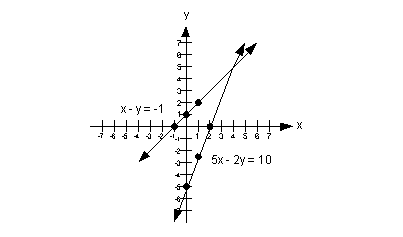
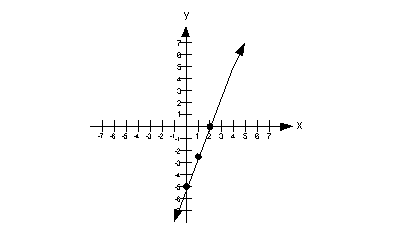
Plotting the ordered pair solutions and drawing the line:
|
 |
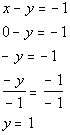
*Plug in 0 for y
for x-int
*x-intercept |
The x-intercept is (-1, 0).
y-intercept |
 |
*Plug in 0 for x
for y-int
*Inverse of mult. by -1 is div. by -1
*y-intercept |
The y-intercept is (0, 1).
Find another solution by letting
x
= 1. |
 |
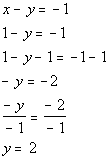
*Plug in 1 for x
*Inverse of add 1 is sub. 1
*Inverse of mult. by -1 is div by -1
|
Another solution is (1, 2).
Solutions:
|
x
|
y
|
(x, y)
|
|
-1
|
0
|
(-1, 0)
|
|
0
|
1
|
(0, 1)
|
|
1
|
2
|
(1, 2)
|
Plotting the ordered pair solutions and drawing the line:
|
| We need to ask ourselves, is there any place that the two lines intersect,
and if so, where?
The answer is yes, they intersect at (4, 5). |
You will find that if you plug the ordered pair (4, 5) into BOTH equations
of the original system, that this is a solution to BOTH of them.
The solution to this system is (4, 5).
(return to problem
1a) |
Answer/Discussion
to 2a

|
| Both of these equations are already simplified. No work needs
to be done here. |
| Neither equation is already solved for either variable. It looks
like equation one is the easiest one to work with. Either x
or y would be fine to solve for in the first
equation since they both have a 1 as a coefficient.
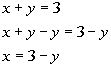
I will choose to solve for x in the first
equation:
(Note it would be perfectly fine to solve for y) |
 |
*Inverse of add y
is sub. y
*Solved for x |
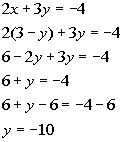
Substitute the expression 3 - y for
x
into the second equation and solve for
y:
(when you plug in an expression like this, it is just like you plug
in a number for your variable) |
 |
*Sub. 3 - y in
for x
*Dist. 2 through ( )
*Combine like terms
*Inverse of add 6 is sub. 6
|
| Plug in -10 for y into the equation
in step 2 to find x's value. |
 |
*Plug in -10 for y |
| You will find that if you plug the ordered pair (13, -10) into BOTH
equations of the original system, that this is a solution to BOTH of them.
(13, -10) is a solution to our system.
(return to problem
2a) |
Answer/Discussion
to 3a

|
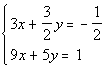
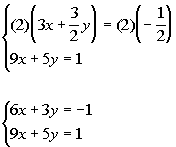
| Since we have some fractions in this problem, let's go ahead and get
rid of them to simplify things.
Multiplying first equation by it's LCD we get: |
 |
*Mult. by LCD of 2
|
| We can either work with the x's or the
y's;
it doesn't matter.
I'm going to choose to work with the x's.
The
smallest number that both 6 and 9 go into is 18. This works
in the same fashion as LCD, you want the smallest number they both go into.
Make one of them positive and the other negative (it doesn't matter which
one is which), so that you have opposites.
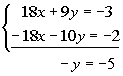
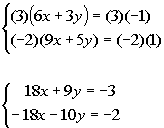
Multiplying the first equation by 3 and the second equation by -2
we get: |
 |
*Mult. both sides of 1st eq. by 3
*Mult. both sides of 2nd eq. by -2
*x's have opposite
coefficients
|
 |
*Note that x's
dropped out |
 |
*Inverse of mult. by -1 is div. by -1 |
| You can choose any equation used in this problem to plug in the found
y
value.
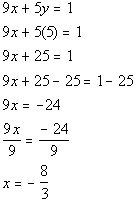
I choose to plug in 5 for y into the
second equation to find x's value. |
 |
*Plug in 5 for y
*Inverse of add 25 is sub. 25
*Inverse of mult. by 9 is div. by 9
|
| You will find that if you plug the ordered pair (-8/3, 5) into BOTH
equations of the original system, that this is a solution to BOTH of them.
(-8/3, 5) is a solution to our system.
(return to problem
3a) |
All contents copyright (C) 2001 - 2008, WTAMU and Kim Seward. All rights reserved. Last revised on Jan. 7, 2002 by Kim Seward. |