Intermediate Algebra
Answer/Discussion to Practice Problems
Tutorial 16: Equations of Lines
 Answer/Discussion
to 1a Answer/Discussion
to 1a
Slope 2/3; y-intercept (0, -2) |
Since we have the slope and the y-intercept,
then we can go right into plugging in 2/3 for m (slope) and -2 for b (y-intercept)
into the slope/intercept form and we will have our equation. |
|
*Slope/intercept form of a line |
y = 2/3 x - 2 is the equation of the line that has a slope of 2/3 and y-intercept
of (0, -2).
(return to problem
1a) |
Answer/Discussion
to 2a
3x + 5y = 10 |
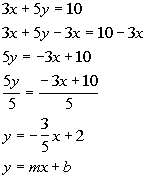 |
*Inverse of add 3x is sub. 3x
*Inverse of mult. by 5 is div. by 5
*Slope/intercept form of the line
|
Looking at this equation and lining it up with the slope/intercept
form, what do you get for the slope and y-intercept?
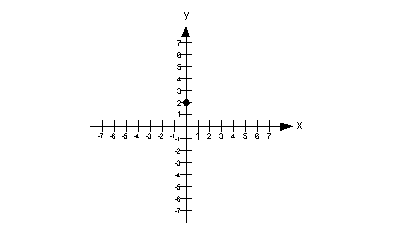
I got m = -3/5 and y-intercept
is 2. |
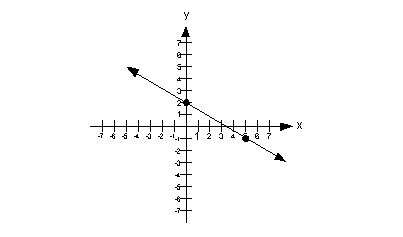
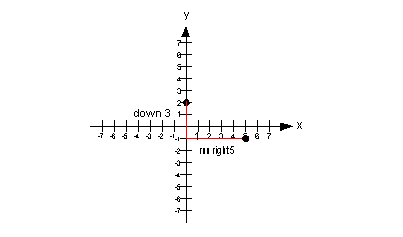
The slope is -3/5.
Starting on the y-intercept (2, 0), we will go down 3 and
run right 5.
|
Answer/Discussion
to 3a
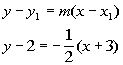
Passes through (-3, 2) and has a slope of -1/2. |
What are the two things we need to write an equation of a line????
If you said any point on the line and the slope, you are correct.
Looks like we have all the information we need. We are ready to
put our equation together. Since we don't have the y-intercept, we
will have to use the point/slope form since that is set up for ANY point (not just the y-int.). |
|
*Point/slope form of the line |
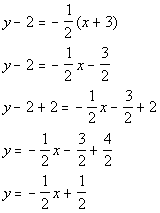
Next, we want to write it in the slope/intercept form, which
basically means we need to solve for y. |
|
*Dist. the -1/2 through ( )
*Inverse of sub. 2 is add 2
*LCD is 2
*Mult. 2/1 by 2/2 to get 4/2
*Slope/intercept form of the line
|
The equation of the line that passes through (-3, 2) and has a slope of -1/2 is y = -1/2 x + 1/2.
(return to problem
3a) |
Answer/Discussion
to 4a
(0, 0) and (5, 10) |
What are the two things we need to write an equation of a line????
If you said any point on the line and the slope, you are correct.
We have more than enough points. However, what about the slope?
Does this mean we can't work out the problem? You are not going to
get off that easily. We do have a way of finding the slope. Tutorial
15: The Slope of a Line shows us how we can get the slope given
two points.
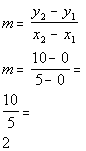
Let's find that slope: |
|
*Slope formula
*Plug in values
*Simplify
|
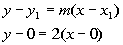
OK, now we have our slope, which is 2. Now we want to put
the slope and one point into the point/slope equation. |
|
*Point/slope form of the line |
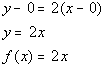
The directions said to write it using function notation. This
means we want to solve it for y (get it in
the slope/int form) and then put it the function notation. |
|
*Dist. 2 through the ( )
*Slope/intercept form of the line
*Function notation
|
Answer/Discussion
to 5a
Slope 0; passes through (1, 2) |
|
Since it passes through (1, 2), and a horizontal line is in the form y = c, where the y value is ALWAYS equal to the same value throughout, this means our equation
would have to be y = 2.
Note that 2 is the y value of the ordered
pair given.
(return to
problem 5a) |
Answer/Discussion
to 5b
Vertical; passes through (-1, -2) |
|
Since it passes through (-1, -2), and a vertical line is in the form x = c,
where the x value is ALWAYS equal to the same
value throughout, this means our equation would have to be x =
-1.
Note that -1 is the x value of the ordered
pair given.
(return to
problem 5b) |
Answer/Discussion
to 6a
Passes through (2, 3) and parallel to 5x + 2y = 4 |
What are the two things we need to write an equation of a line????
If you said any point on the line and the slope, you are correct.
We have our point. However, what about the slope?
We need to do a little digging to get it.
Recall that Tutorial
15: The Slope of a Line tells us that parallel lines have the same slope.
So, if we know the slope of the line parallel to our line, we have it made.
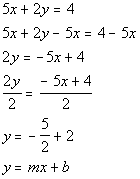
Find the slope of the parallel line: |
|
*Inverse of add 5x is sub. 5x
*Inverse of mult. by 2 is div. by 2
*Slope/intercept form of the line
|
Now, keep in mind that this is not the equation of our line but of
the line parallel to our line. We needed to write it this way so
we could get the slope. And it looks like the slope is -5/2. And
since our line is parallel to a line that has a slope of -5/2, our line
also has a slope of -5/2.
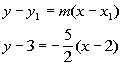
OK, now we have our slope, which is -5/2. Now we want to put
the slope and one point into the point/slope equation. |
|
*Point/slope form of the line |
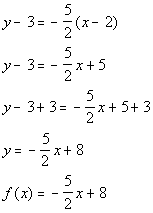
The directions said to write it using function notation. This
means we want to solve it for y (get it in
the slope/int form) and then put it in function notation. |
|
*Dist. -5/2 through ( )
*Inverse of sub. 3 is add 3
*Slope/intercept form of the line
*Function notation
|
The line that passes through (2, 3) and is parallel to 5x + 2y = 4 is f(x) = -5/2 x + 8.
(return to
problem 6a) |
Answer/Discussion
to 6b
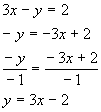
Passes through (-1, 0) and perpendicular to 3x - y = 2 |
|
*Subtract 3x from both sides
*Inverse of mult. by -1 is div. by -1
*Slope/intercept form of the line
|
In this form, we can tell that the slope of this line is 3. Since
our line is perpendicular to this, we need to take the negative reciprocal
of 3 to get our slope.
What did you come up with?
I came up with -1/3 for the slope of our line.
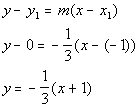
Now we can go on to the equation of our line: |
|
*Point/slope form of the line |
The directions said to write it using function notation. This
means we want to solve it for y (get it in
the slope/int form) and then put it in function notation. |
|
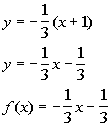
*Dist. -1/3 through the ( )
*Slope/intercept form of the line
*Function notation |
The line that passes through (-1, 0) and is perpendicular to 3x - y = 2 is f(x)
= -1/3 x - 1/3.
(return to
problem 6b) |

Last revised on July 5, 2011 by Kim Seward.
All contents copyright (C) 2001 - 2011, WTAMU and Kim Seward.
All rights reserved.
|
|