(Back to the tutorial on long division)

College Algebra
Answer/Discussion to Practice Problems
on Long Division


Answer/Discussion to 1a


Step 1: Set up the long division.

 
*Write in descending order


Step 2:  Divide 1st term of dividend by first term of divisor to get first term of the quotient.

 
Note that the "scratch work" that you see at the right of the long division shows you how that step is filled in.  It shows you the "behind the scenes" of how each part comes about. 

 
Scratch work:

 
Step 3:  Take the term found in step 2 and multiply it times the divisor.

 
Scratch work:


Step 4:  Subtract this from the line above.

 
Scratch work:


Step 5:  Repeat until done.

 
We keep going until we can not divide anymore. 

We just follow the the same steps 2 - 4 as shown above.  Our "new dividend" is always going to be the last line that was found in step 4.


Step 2 (repeated): Divide 1st term of dividend by first term of divisor to get next term of the quotient.

AND


Step 3 (repeated): Take the term found in step 2 and multiply it times the divisor.

AND


Step 4 (repeated): Subtract this from the line above.

 
The following is the scratch work (or behind the scenes if you will) for the rest of the problem.  You can see everything put together following the scratch work under "putting it all together".  This is just to show you how the different pieces came about in the final answer.  When you work a problem like this, you don't necessarily have to write it out like this.  You can have it look like the final product shown after this scratch work.

 
Scratch work for steps 2, 3, and 4
for the last two terms of the quotient

2nd term:


3rd term:


Putting it all together:

Note that each second line is SUBTRACTED, so the line shows what the signs of each term would be when you subtract it. 
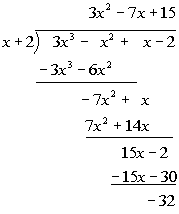


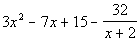
Step 6: Write out the answer.

 
*Quotient with a remainder of -32

 
(return to problem 1a)


Answer/Discussion to 1b


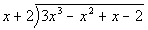
Step 1: Set up the long division.

 
*Write in descending order
*Insert 0's for missing terms


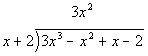
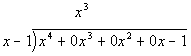
Step 2:  Divide 1st term of dividend by first term of divisor to get first term of the quotient.

 
Note that the "scratch work" that you see at the right of the long division shows you how that step is filled in.  It shows you the "behind the scenes" of how each part comes about. 

 
Scratch work:

 
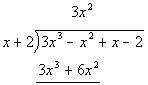
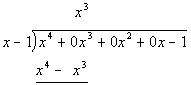
Step 3:  Take the term found in step 2 and multiply it times the divisor.

 
Scratch work:


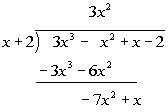
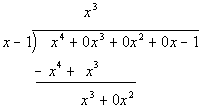
Step 4:  Subtract this from the line above.

 
Scratch work:


Step 5:  Repeat until done.

 
We keep going until we can not divide anymore. 

We just follow the the same steps 2 - 4 as shown above.  Our "new dividend" is always going to be the last line that was found in step 4.


Step 2 (repeated): Divide 1st term of dividend by first term of divisor to get next term of the quotient.

AND


Step 3 (repeated): Take the term found in step 2 and multiply it times the divisor.

AND


Step 4 (repeated): Subtract this from the line above.

 
The following is the scratch work (or behind the scenes if you will) for the rest of the problem.  You can see everything put together following the scratch work under "putting it all together".  This is just to show you how the different pieces came about in the final answer.  When you work a problem like this, you don't necessarily have to write it out like this.  You can have it look like the final product shown after this scratch work.

 
Scratch work for steps 2, 3, and 4
for the last three terms of the quotient

2nd term:


3rd term:


4th term:


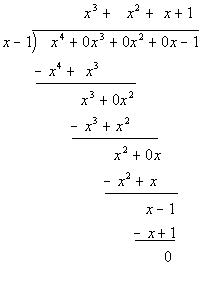
Putting it all together:

Note that each second line is SUBTRACTED, so the line shows what the signs of each term would be when you subtract it. 


Step 6: Write out the answer.

 
*Quotient with no remainder

 
(return to problem 1b)


(Back to the tutorial on long division)


All contents copyright (C) 2002 - 2008, WTAMU and Kim Seward. All rights reserved.
Last revised on October 10, 2002 by Kim Seward.