
 Answer/Discussion
to 1a
Answer/Discussion
to 1a

 )
and identify the slope and y-intercept.
)
and identify the slope and y-intercept.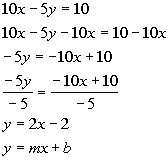
*Inverse of mult. -5 is div. -5
*Slope/intercept form
In this form, the slope is m, which is the number in front of x. In our problem that would have to be 2.
In this form, the y-intercept is b, which is the constant. In our problem that would be -2.
How did you do?
Putting that together, the ordered pair for the y-intercept
would be (0, -2):
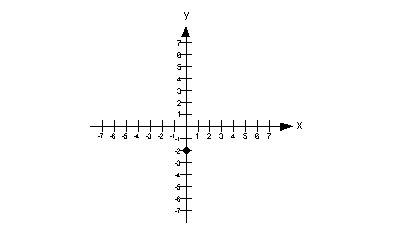
Since we have a positive slope the rise and the run need to either be BOTH positive or BOTH negative. So, we can either rise up 2 and run right 1 OR go down 2 and left 2.
I chose to rise up 2 and run right 1, starting on the y-intercept:
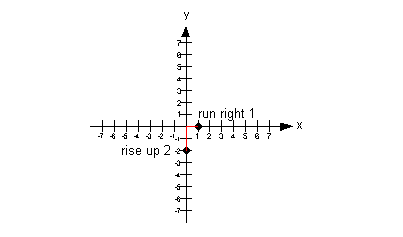
Note that if we would have gone down 2 and left 1 from our y-intercept, that we would have ended up at (-1, -4) which would have lined up with the other points.
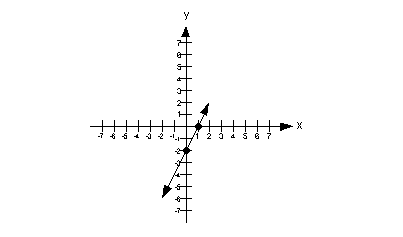
Answer/Discussion
to 1b

)
and identify the slope and y-intercept.
In this form, the slope is m, which is the number in front of x. In our problem that would have to be -2/3.
In this form, the y-intercept is b, which is the constant. In our problem that would be 0.
How did you do?
Putting that together, the ordered pair for the y-intercept
would be (0, 0):
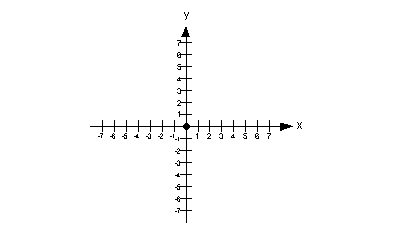
Since we have a negative slope the rise and the run have to be opposites of each other, one has to be positive and one has to be negative. So, we can either go down 2 and run right 3 OR rise up 2 and run left 3.
I chose to go down 2 and run right 3, starting on the y-intercept:
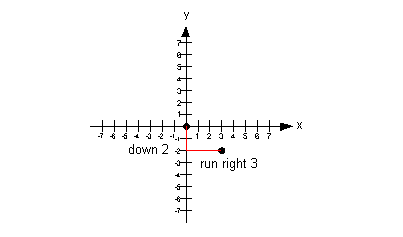
Note that if we would have rose up 2 and ran left 3 from our y-intercept, that we would have ended up at (-3, 2) which would have lined up with the other points.
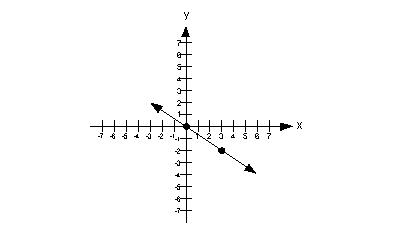
Answer/Discussion
to 1c

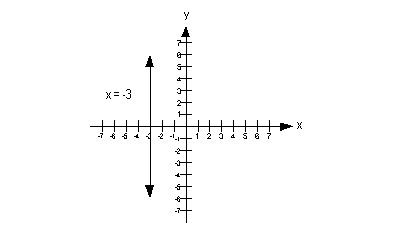
Since we have a vertical line, what is our slope going to be? If you said undefined, you are so right!!!
What would the y-intercept be? Give
yourself a high five if you said there is no y-intercept.
Answer/Discussion
to 1d

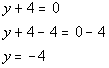
Lets first rewrite this in the form y = c and then go from there:
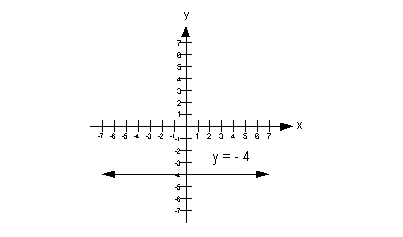
Since we have a horizontal line, what is our slope going to be? If you said 0, you are so right!!!
What would the y-intercept be? Give
yourself a high five if you said -4.

Last revised on Feb. 11, 2010 by Kim Seward.
All contents copyright (C) 2002 - 2010, WTAMU and Kim Seward. All rights reserved.