
 Answer/Discussion
to 1a
Answer/Discussion
to 1a

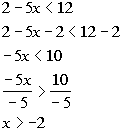
Interval notation:
Graph:
*Inv. of mult. by -5 is div. both sides by
-5, so reverse inequality sign
*Open interval indicating all values greater
than -2
*Visual showing all numbers greater than -2
on the number line
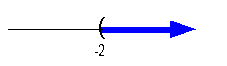
Graph:
We use the same type of notation on the endpoint as we did in the interval
notation, a curved end. Since we needed to indicate all values
greater than -2, the part of the number line that was to the right of -2
was darkened.
Answer/Discussion
to 1b

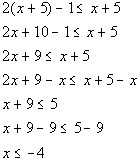
Interval notation:
Graph:
*Get x terms on one side, constants on the other side
*Inv. of add. 9 is sub. by 9
*Closed interval indicating all values less
than or = to -4
*Visual showing all numbers less than or =
to -4 on the number line
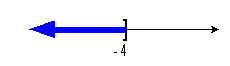
Graph:
Again, we use the same type of notation on the endpoint as we did in
the interval notation, a boxed end. Since we needed to indicate all
values less than or equal to -4, the part of the number line that was to
the left of -4 was darkened.
Answer/Discussion
to 1c

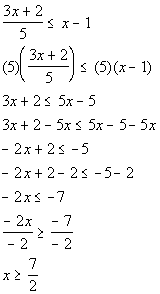
Interval notation:
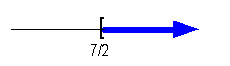
Graph:
*Get x terms on
one side, constants on the other side
*Inv. of add. 2 is sub. by 2
*Inv. of mult. by -2 is div. both sides by
-2, so reverse inequality sign
*Closed interval indicating all values greater
than or equal to 7/2
*Visual showing all numbers greater than or equal to 7/2 on the number line
Graph:
Again, we use the same type of notation on the endpoint as we did in
the interval notation, a boxed end this time. Since we needed
to indicate all values greater than or equal to 7/2, the part of the number
line that was to the right of 7/2 was darkened.
Answer/Discussion
to 2a

AND
Step 3: Solve
the linear inequalities set up in step
2.
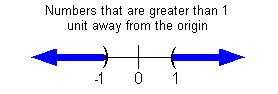
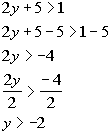
All numbers that are less than -1 OR greater than 1 are greater than
1 unit away from the origin. So the expression 2y + 5 needs to be less than -1 OR greater than 1.
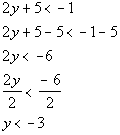
OR
Interval notation:
Graph:

*Inv. of mult. by 2 is div. by 2
*Second inequality, where it is greater than
1
*Inv. of add. 5 is sub. 5
*Inv. of mult. by 2 is div. by 2
*All values less than -3 or greater than -2
*Visual showing all numbers less than -3 or
greater than -2
In the first interval, y is less than -3, so -3 is our largest value of the interval so it goes on the right. Since there is no lower endpoint of that first interval, we put negative infinity on the left side. The curved end on -3 indicates an open interval. Infinity always has a curved end because there is not an endpoint on that side.
In the second interval, y is greater than -2, so -2 is our smallest value of the interval so it goes on the left. Since there is no upper endpoint of that second interval, we put the infinity symbol on the right side. The curved end on -2 indicates an open interval. Infinity always has a curved end because there is not an endpoint on that side.
Graph:
Again, we use the same type of notation on the endpoints as we did
in the interval notation, a curved end on both y = -3 and y = -2. Since we needed to indicate
all values less than -3 OR greater than -2, the parts of the number line
that are to the left of -3 and to the right of -2 were darkened.
Answer/Discussion
to 2b

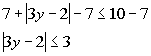
*Abs. value exp. isolated
AND
Step 3: Solve
the linear inequalities set up in step
2.
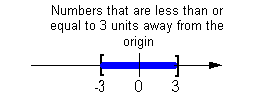
All numbers between -3 and 3 are less than 3 units away from the origin.
So, the expression 3y - 2 needs to be between
-3 and 3.
Interval notation:
Graph:

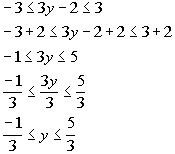
*Inv. of mult. by 3 is div by 3
*Apply steps to all three parts
*Closed interval indicating all values between
-1/3 and 5/3, inclusive
*Visual showing all numbers between -1/3 and 5/3, inclusive
Graph:
Again, we use the same type of notation on the endpoints as we did
in the interval notation, a boxed end on both ends. Since we
needed to indicate all values between -1/3 and 5/3, the part of the
number line that is in between -1/3 and 5/3 was darkened.
Answer/Discussion
to 2c

AND
Step 3: Solve
the linear inequalities set up in step
2.
Answer/Discussion
to 2d

AND
Step 3: Solve
the linear inequalities set up in step
2.

Last revised on Dec. 29, 2009 by Kim Seward.
All contents copyright (C) 2002 - 2010, WTAMU and Kim Seward.
All rights reserved.