Learning Objectives
Introduction
Tutorial
Most of you are probably familiar with associating slope
with "rise
over run".
Run means how far left or right you move from point to point. On the graph, that would mean a change of x values.
Here are some visuals to help you with this
definition:
Positive slope:
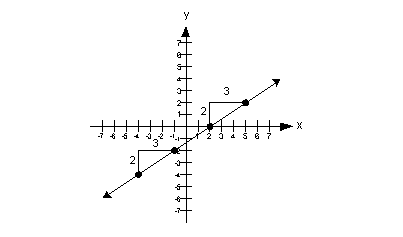
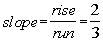
Note that when a line has a positive slope it goes up left to right.
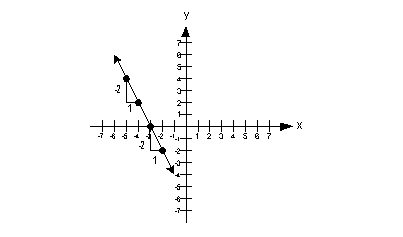
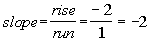
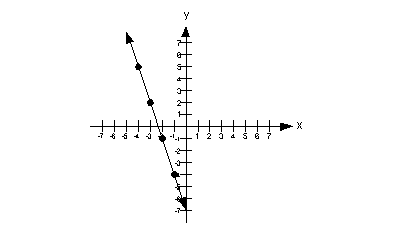
Note that when a line has a negative slope it goes down left to right.
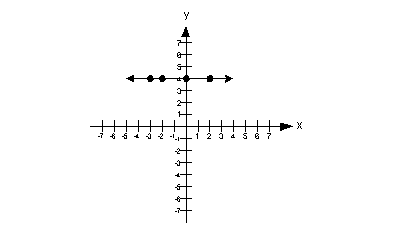
slope = 0
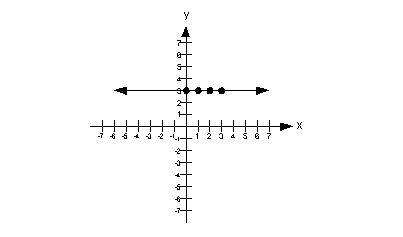
Note that when a line is horizontal the slope is 0.
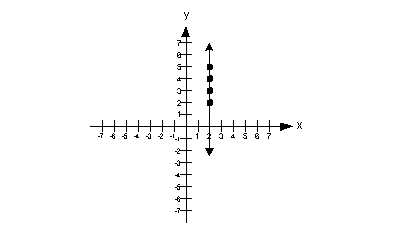
slope = undefined
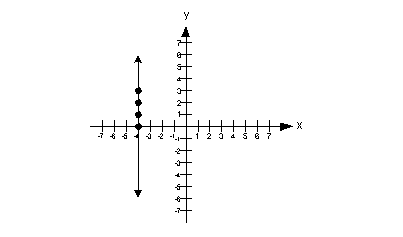
Note that when the line is vertical the slope is undefined.
Given two points  and
and 
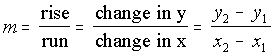
Note that we use the letter m to represent slope.
 Example
1: Find the slope of the straight line that passes through
(-5,
2) and (4, -7).
Example
1: Find the slope of the straight line that passes through
(-5,
2) and (4, -7).

*Simplify
The slope of the line is -1.
Example
2: Find the slope of the straight line that passes
through
(1, 1) and (5, 1).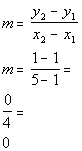
*Simplify
The slope of the line is 0.
Example
3: Find the slope of the straight line that passes through
(3,
4) and (3, 6).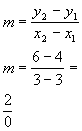
*Simplify
The slope of the line is undefined.
Parallel Lines and Their Slopes
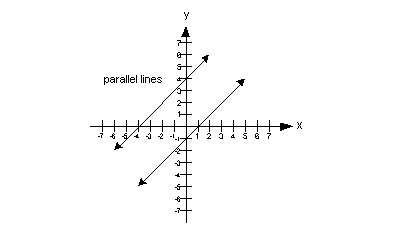
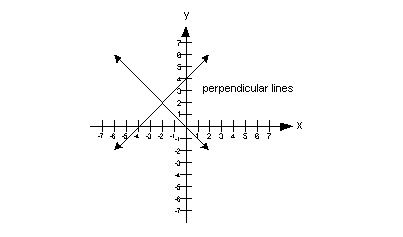
Note that two lines are parallel if there slopes are equal and they have different y-intercepts.

Practice Problems
To get the most out of these, you should work the problem out on your own and then check your answer by clicking on the link for the answer/discussion for that problem. At the link you will find the answer as well as any steps that went into finding that answer.
Practice Problems 1a - 1d: Find the slope of each line if it exists.
2a. (3, 5) and (-1, -8)
(answer/discussion
to 2a)
Need Extra Help on these Topics?
The following is a webpage
that can assist
you in the topics that were covered on this page:
http://www.purplemath.com/modules/slope.htm
This webpage helps you with slope.
Go to Get Help Outside the Classroom found in Tutorial 1: How to Succeed in a Math Class for some more suggestions.

Last revised on July 31, 2011 by Kim Seward.
All contents copyright (C) 2001 - 2011, WTAMU and Kim Seward. All rights reserved.